

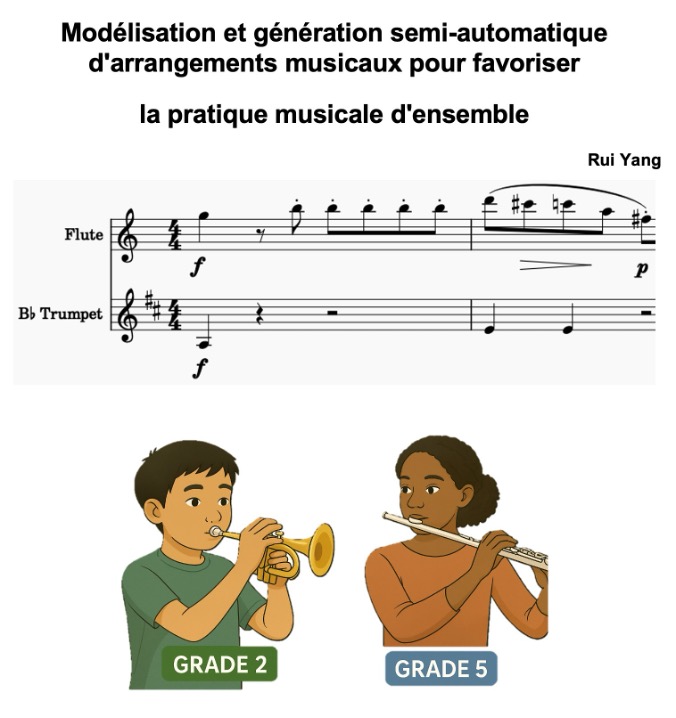
What can a beginner trumpet player and an experienced flutist play together?
Published · Updated
A reflection on difficulty, ensemble playing, and how adaptive arrangements could support mixed-level musicians.
Written by Rui Yang
Whether in music schools, amateur ensembles, or simply at home, playing together is not always straightforward. Advanced parts may be impossible for beginners, while overly simplified music can quickly frustrate more experienced players.
My research in the Algomus team at the CRIStAL laboratory (Université de Lille) starts from a simple question:
what can musicians of different levels realistically play together?
I explore the idea of difficulty-adapted musical arrangements, where different parts of the same piece are tailored to each player's level, while preserving the musical coherence of the ensemble.
Imagine a beginner trumpet player in their first weeks of practice playing alongside a more experienced flutist. Instead of slowing everything down or simplifying the entire score, each musician could receive a part adapted to their own abilities.
The beginner might play a simplified melodic line with accessible notes and rhythms, while the more advanced player performs a richer and more technically demanding version. Both musicians can then play together at the same tempo, sharing the same musical moment -- each appropriately challenged.
To make this possible, my work combines musical knowledge with computational approaches. I collaborate with instrumental teachers to build a dataset on how difficulty is perceived across different instruments and pedagogical systems. This helps us better understand:
- - what makes a piece simple or complex
- - how difficulty differs between instruments
- - how this knowledge could guide the generation of adaptable ensemble arrangements
I will also soon undertake a research stay at the Music Technology Group (Barcelona), exploring how symbolic music models could support this process.
The long-term goal is to develop tools that support teachers and musicians in creating flexible arrangements -- making ensemble playing accessible earlier, and allowing people of different levels to share the pleasure of making music together.
If you are an instrumental teacher, you are very welcome to contribute to this research.
The study is a short online task (≈20-30 minutes), where you rate the difficulty of a few short excerpts using your usual grading system (ABRSM, RCM, Trinity, CCOM, or French).
More information:
https://grading.algomus.fr/
Related articles
Beyond the Score: Teaching Students to Improvise with the 12-Bar Blues
Teaching the 12 Bar Blues by Australian piano teacher and TopMusic founder Tim Topham is a practical course designed to help piano teachers introduce improvisation--even if they have little or no improvisation or jazz experience themselves. Through ten short, structured lessons, teachers learn how to introduce the 12-bar blues, blues scales, grooves, chords, and improvisation in a way that students can quickly enjoy and understand. The updated 2026 edition adds practical teaching tools including the Blues Jam Room, an AI blues coach, customizable handouts, a companion workbook, and an audio version of the course. At its heart, the course is about giving students another way to experience music: not only playing what is written on the page, but listening, experimenting, creating, and enjoying the freedom of improvisation.
Sonatico Team ·
Adapting to Online Music Teaching: Strategies for Success
Explore effective strategies to adapt music teaching to an online environment, ensuring student engagement and holistic learning.
Sonatico App ·
Transforming Challenges into Opportunities: A Music Teacher's Success Story
Discover how a music teacher turned the COVID-19 pandemic challenge into a success by creating an innovative app that revolutionized online music teaching.
Administrator ·


Conversation
No comments yet. Start the conversation.
Join the conversation