
Beyond the Score: Teaching Students to Improvise with the 12-Bar Blues
Published · Updated
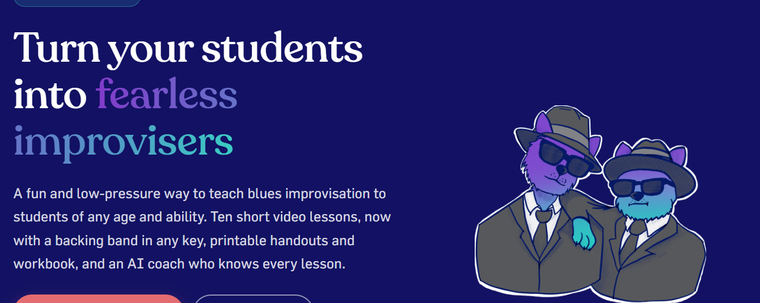
Teaching the 12 Bar Blues by Australian piano teacher and TopMusic founder Tim Topham is a practical course designed to help piano teachers introduce improvisation--even if they have little or no improvisation or jazz experience themselves. Through ten short, structured lessons, teachers learn how to introduce the 12-bar blues, blues scales, grooves, chords, and improvisation in a way that students can quickly enjoy and understand. The updated 2026 edition adds practical teaching tools including the Blues Jam Room, an AI blues coach, customizable handouts, a companion workbook, and an audio version of the course. At its heart, the course is about giving students another way to experience music: not only playing what is written on the page, but listening, experimenting, creating, and enjoying the freedom of improvisation.
How to Teach the 12-Bar Blues — Even If You’ve Never Improvised
Many excellent piano teachers were trained to play what is written on the page — and to teach their students to do the same.
But what happens when a student asks:
“Can I just make something up?”
For teachers who were never taught to improvise themselves, that simple question can suddenly take us outside familiar territory.
That is the problem Australian piano teacher and TopMusic founder Tim Topham addresses in his newly updated course, Teaching the 12 Bar Blues.
And what I find particularly interesting about his approach is that it doesn’t require teachers to become jazz musicians first.
 Start with three chords
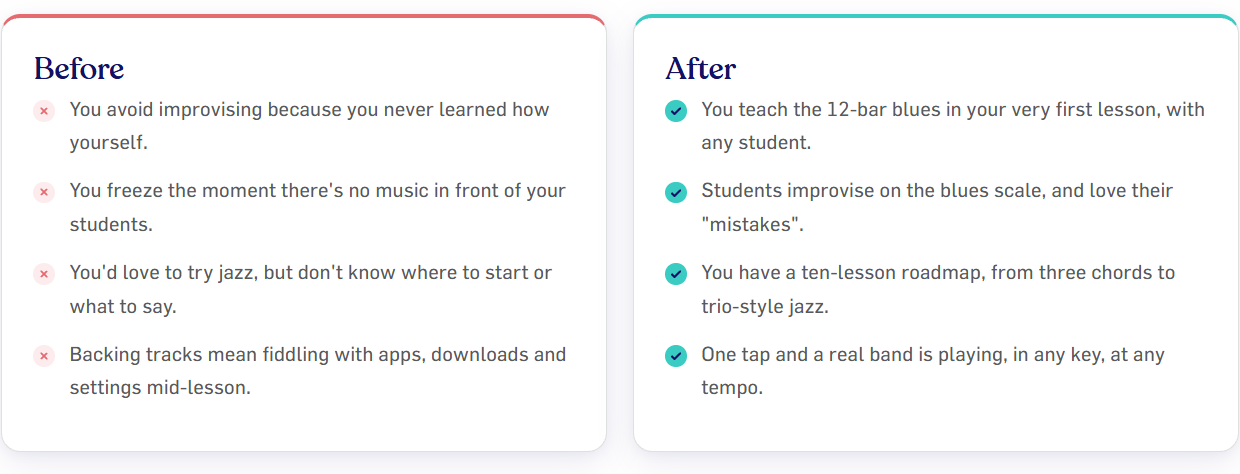
The idea is surprisingly simple: begin with the 12-bar blues structure and get students making music as quickly as possible.
The course contains ten short video lessons, each around 8–13 minutes. Teachers can learn an idea and then bring it directly into the next lesson.
Students begin with the 12-bar chord pattern and blues scale, then gradually explore left-hand grooves, crushes, slides, triplets, different keys, extended chords, comping and eventually playing chords in one hand while improvising with the other.
No previous jazz experience is required.
That makes the course particularly interesting for teachers who like the idea of improvisation but have never felt completely comfortable teaching it.
Why this matters
Improvisation can do something that traditional repertoire sometimes cannot.
It gives students permission to experiment.
There is no single “correct” performance they are trying to reproduce. They listen, respond, make decisions and discover what happens next.
And sometimes that can reconnect a student with the simple pleasure of making music.
One teacher who used the course described trying the first lesson with a student who rarely practiced:
“He got a big goofy smile on his face and laughed while he started playing.”
Another teacher introduced the blues to a 17-year-old student who had been studying for around ten years and was feeling pressure from life:
“Boy, you should have seen his face light up!!”
Those reactions say something important about improvisation: sometimes a student doesn’t need another piece.
Sometimes they need a different way to experience the instrument.
 More than a video course
The 2026 edition adds several practical tools designed to move the course from “something the teacher watches” into something that can actually be used during lessons and practice.
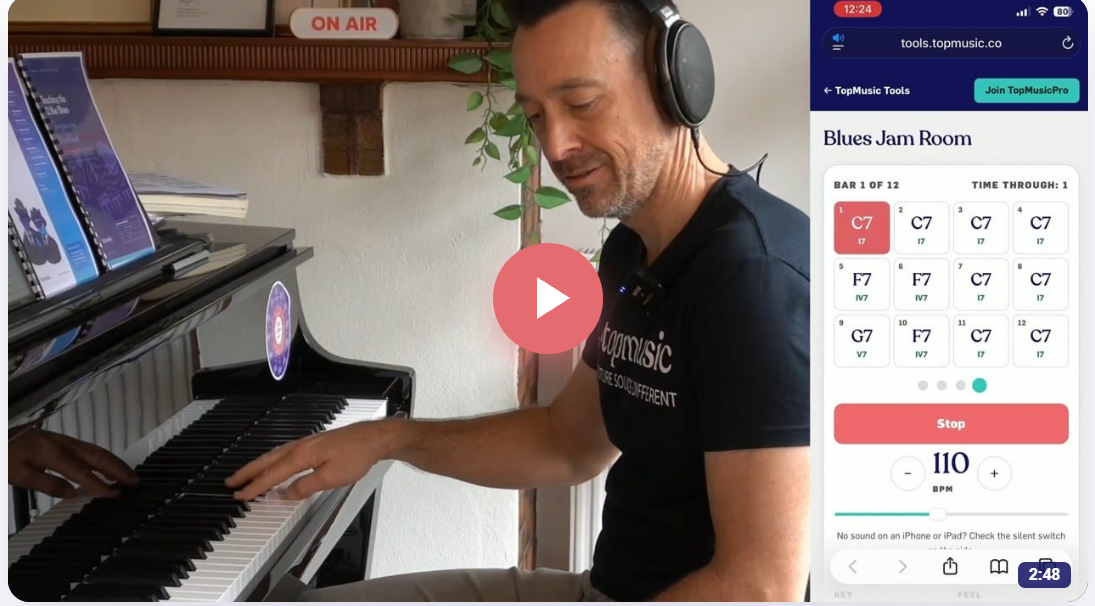
One of the most interesting is the Blues Jam Room — a backing-band tool with recorded piano, upright bass and drums. Teachers can choose the key, tempo and style, remove the piano part, and let the student become the pianist in the band.
The same jam can then be shared with the student for home practice.
The update also includes:
- Ask Bronson, an AI blues coach trained around the course material that can help teachers adapt ideas for individual students and point them back to relevant moments in the lessons;
- a Handout Generator for creating charts, scales and patterns in different keys;
- redesigned lesson handouts;
- a companion workbook;
- and an audio version of the course for teachers who prefer to learn between lessons or while travelling.
A practical entry point into improvisation
What I like about the concept is that it doesn’t ask teachers to completely change the way they teach.
It gives them a structured entry point into something many of us would like to include more often: creative music-making without the page.
And the 12-bar blues is particularly well suited to that.
The structure is predictable enough to give students security, while leaving enough freedom for them to experiment, listen and create.
For a teacher who has thought, “I’d love to teach improvisation, but I’m not quite sure where to begin,” this may be a very practical place to start.
Teaching the 12 Bar Blues is available directly from TopMusic. The course costs US$99 as a one-off purchase with 12 months of access and updates, and it is also included with TopMusicPro Studio membership.
Learn more about Teaching the 12 Bar Blues:
Course information and teacher testimonials provided by TopMusic.
Related articles
What can a beginner trumpet player and an experienced flutist play together?
A reflection on difficulty, ensemble playing, and how adaptive arrangements could support mixed-level musicians.
Sonatico Team ·
Adapting to Online Music Teaching: Strategies for Success
Explore effective strategies to adapt music teaching to an online environment, ensuring student engagement and holistic learning.
Sonatico App ·
Transforming Challenges into Opportunities: A Music Teacher's Success Story
Discover how a music teacher turned the COVID-19 pandemic challenge into a success by creating an innovative app that revolutionized online music teaching.
Administrator ·


Conversation
No comments yet. Start the conversation.
Join the conversation