
Why Some Musicians Learn Faster Than Others (And It Has Nothing to Do With Talent)
Published · Updated
Learn why understanding chord progressions, scales, and the number system can make music theory dramatically easier. Discover the pattern-based approach used by experienced musicians.
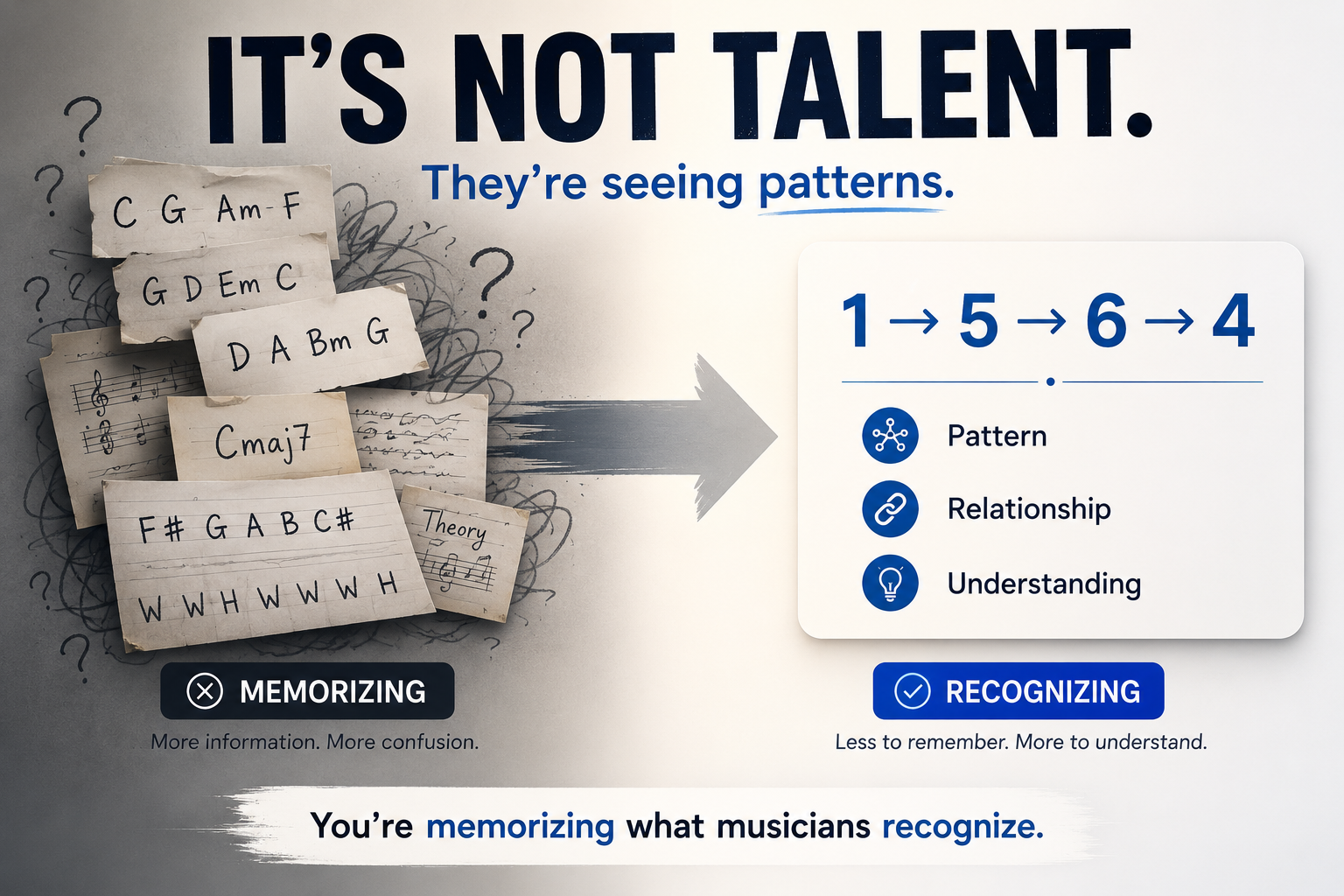
One of the biggest myths in music education is that great musicians simply know more than everyone else.
They don't.
In fact, many advanced musicians are carrying less information in their heads than beginners.
That sounds impossible until you realize something important:
The best musicians aren't memorizing more facts.
They're seeing more patterns.
And once you understand this, music theory, scales, chord progressions, and even learning songs start to feel very different.
The Problem Most Students Don't Realize They're Having
Imagine two piano students learning the same song.
The first student sees:
C – G – Am – F
The second student sees:
1 – 5 – 6 – 4
Both can play the song.
But only one of them understands what they're looking at.
The first student has memorized four chords.
The second student has learned a pattern that appears in hundreds of songs.
This is why some musicians seem to learn music so quickly.
It isn't because they're more talented.
They're simply learning relationships instead of isolated facts.
Why the Number System Changes Everything
Every major key contains seven notes.
In C major, those notes are:
C, D, E, F, G, A, B
Each note can be assigned a number:
1 = C
2 = D
3 = E
4 = F
5 = G
6 = A
7 = B
From each note, you can build a chord.
The chord built on the first note becomes the 1 chord.
The chord built on the fourth note becomes the 4 chord.
The chord built on the fifth note becomes the 5 chord.
And suddenly something interesting happens.
Instead of memorizing:
C – G – Am – F
You start seeing:
1 – 5 – 6 – 4
And this is where most students suddenly realize they've been memorizing far more than necessary.
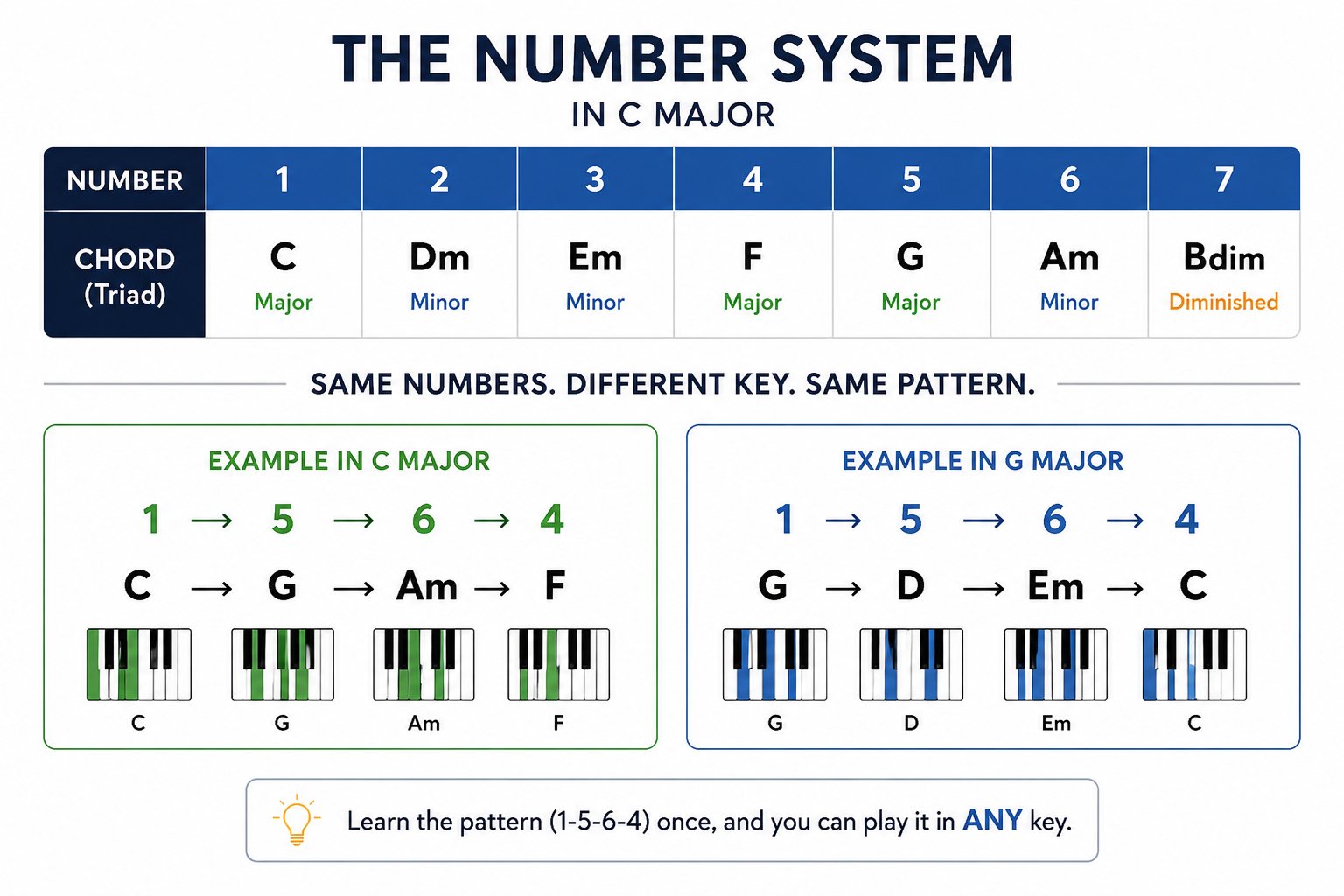
Now the progression can move to any key.
In C major:
1 – 5 – 6 – 4
becomes:
C – G – Am – F
In G major:
1 – 5 – 6 – 4
becomes:
G – D – Em – C
Different chords.
Same pattern.
Once you see this, hundreds of songs stop feeling random.
You begin to recognize the structure underneath them.
Scales Become Easier Too
Most students try to memorize scales note by note.
C major:
C D E F G A B
G major:
G A B C D E F#
D major:
D E F# G A B C#
Eventually it starts to feel like an endless list of information.
But every major scale follows exactly the same pattern:
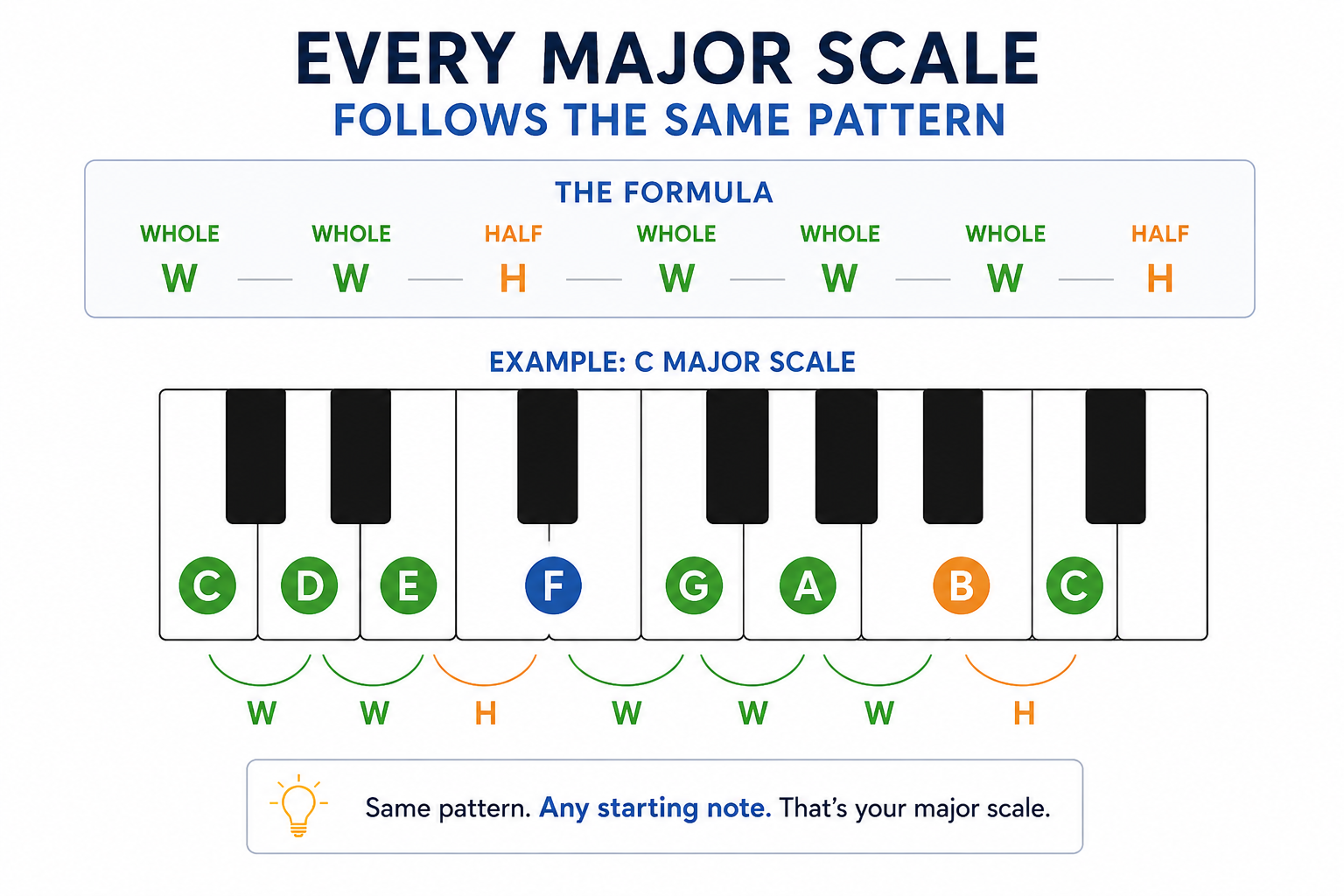
Every major scale follows this exact formula.
Once most students see this for the first time, they realize they don't actually need to memorize dozens of scales.
They only need to remember one pattern.
The moment you understand the formula, you stop memorizing scales and start building them.
The information becomes smaller.
The understanding becomes bigger.
The Real Purpose of Music Theory
Many people think music theory is about learning complicated terms and symbols.
It isn't.
Music theory is translation.
When a beginner sees:
Cmaj7
they see letters.
When an experienced musician sees:
Cmaj7
they hear a sound.
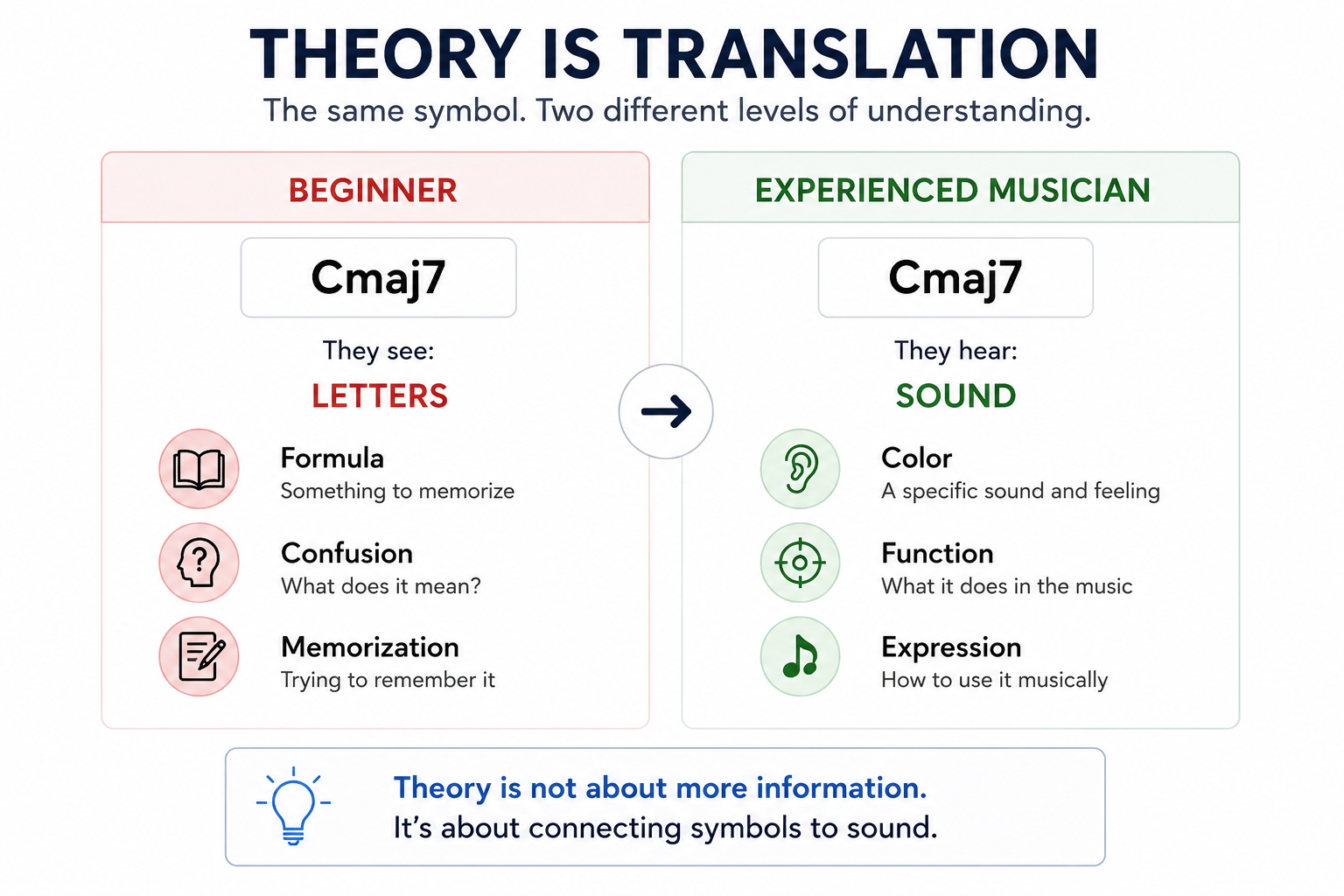
The goal of theory isn't to collect information.
The goal is to connect symbols to sound.
That's a completely different skill.
Why This Matters More Than Most Students Realize
Most people assume learning music means collecting more information.
More scales.
More chords.
More theory.
More songs.
But the musicians who improve the fastest often do the opposite.
Instead of collecting more information, they start compressing it.
One pattern replaces twenty songs.
One formula replaces twelve scales.
One concept explains hundreds of chord progressions.
This is why advanced musicians often appear to learn faster.
They're not carrying more information.
They're carrying better systems.
Why Music Suddenly Feels Easier
This is why some musicians seem to learn songs, scales, chords, and theory much faster than others.
They're not necessarily smarter.
They're not necessarily more talented.
At some point, they stopped memorizing disconnected facts and started recognizing patterns.
And once that happens, something surprising occurs.
You stop feeling like you're trying to crack a secret code.
Music starts feeling like a language.
A language where the same ideas appear over and over again in different forms.
Most beginners spend years collecting information.
Better musicians spend their time connecting it.
That's the real difference.
And once you start seeing patterns, hundreds of musical ideas suddenly begin to make sense at the same time.
Conversation (2)
Join the conversationPaul
1111
Paul
123123