
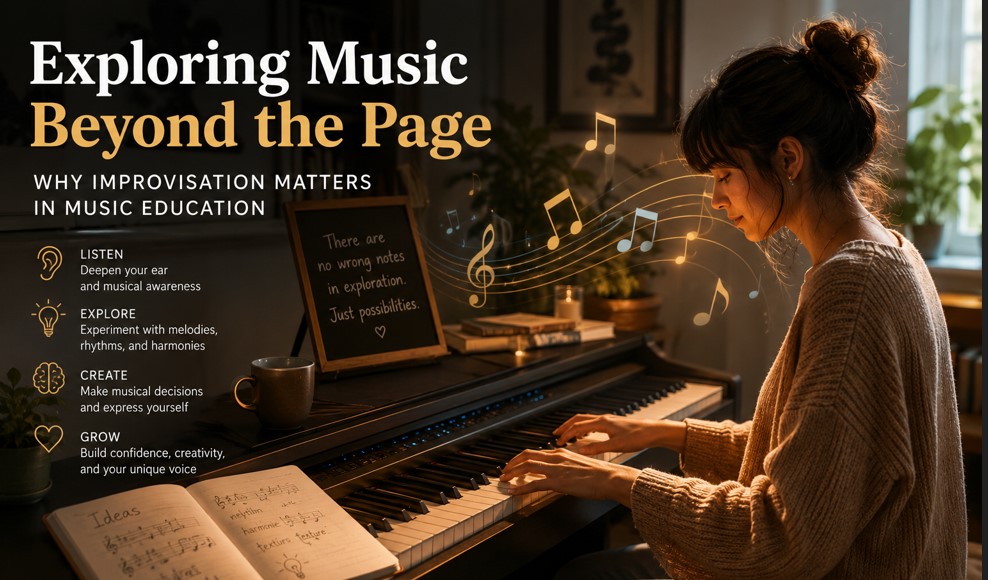
Exploring Music Beyond the Page
Published · Updated
Improvisation encourages musicians to move beyond notation and explore sound creatively through listening, experimentation, and spontaneous musical decision-making. Alongside technique, repertoire, and music theory, creative exploration helps develop ear training, confidence, musical intuition, and a deeper personal connection to music.
Why improvisation matters in music education
Many musicians spend years developing technique, learning scales, refining repertoire, and improving their ability to read music notation. All of this is essential. But alongside performance, ear training, and music theory, there is another part of musical growth that is often overlooked: simply exploring sound. Not for an exam. Not for a performance. Just to listen, experiment, and play.
For many classically trained musicians, improvisation can feel unfamiliar or even intimidating. After spending so much time learning to reproduce music accurately, the idea of creating something spontaneously raises an immediate question:
Where do you even begin?
That hesitation is common in music education, especially in environments where progress is measured primarily through notation and prepared repertoire. Yet improvisation offers something very different. It shifts the focus from correctness to curiosity.
In daily practice, even a few moments of free musical exploration can change the relationship a musician has with sound. Playing with melodies, rhythms, harmonies, textures, or unusual patterns without worrying about mistakes creates space for discovery.
Some ideas may sound strange at first.
Some may not lead anywhere.
But over time, something important begins to happen:
the musician starts listening differently.
This is one of the hidden values of learning music by ear and improvisation. The brain is actively making musical decisions in real time -- shaping phrasing, dynamics, rhythm, balance, form, and emotional direction. Improvisation strengthens creativity, but it also deepens listening and musical awareness.
For students, this process can be incredibly freeing.
Instead of only interpreting existing music, they begin to develop their own musical voice. Improvisation also supports:
- ear training
- musical confidence
- rhythmic flexibility
- expressive playing
- deeper understanding of harmony and structure
This is why many teachers are rethinking the role of creative music practice alongside traditional notation-based learning.
Improvisation does not need to be complicated.
It can begin with:
- repeating a simple rhythm
- changing a melody slightly
- experimenting with dynamics
- playing over a drone, metronome, or drum machine
Even recording short musical ideas can become part of the process. Listening back helps students hear their instincts, habits, and musical choices more clearly.
In a world where musicians often focus on accuracy and visible progress, improvisation reminds us that music is also exploration.
Not everything meaningful in music starts on the page.
Sometimes it begins with curiosity, listening, and the willingness to simply play.
What this supports
- improvisation in music education
- learning music by ear
- creative music practice
- ear training and musical listening
- developing musical confidence
- exploring harmony and rhythm freely
- balancing notation and creativity in music lessons
Related articles
Lifelong Learning for Music Teachers: Why Great Teachers Keep Learning
The best music teachers never stop being students themselves. This reflection explores how lifelong learning, professional development, and discovering new music education resources help teachers grow, inspire their students, and become more effective educators.
John Lettieri ·
Why Music Teachers Should Remain Active Professional Musicians
The best music teachers never stop being musicians. Active performance enriches teaching, while teaching develops the skills that help musicians continue growing throughout their careers.
John Lettieri ·
Technology that supports learning
I have been exploring Sonatico since the fall of 2022, and it is an available technology that supports learning in many ways. The application offers many helpful tools such as the piano keyboard. It is easy to use and technical support is always ready to assist to resolve any issues. For me, the main feature is the sound / video quality - which is high quality.
John Lettieri ·

Conversation
No comments yet. Start the conversation.
Join the conversation