
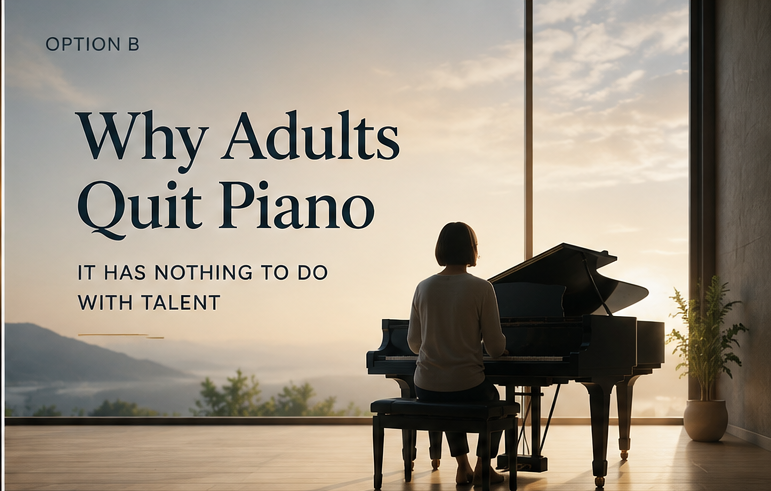
Why Adults Quit Piano (And Why It Has Nothing To Do With Talent)
Published
Most adults who quit piano assume they lack talent, but the real problem is often the learning process itself. Many students spend months practicing scales, exercises, and theory without experiencing the thing that motivated them to start: making music. When students connect learning to real musical experiences early, motivation becomes natural and progress accelerates. The issue is rarely talent. More often, it's the order in which music is taught.
One of the most common beliefs among adult piano students is also one of the most damaging.
After months—or sometimes years—of effort, many eventually arrive at the same conclusion:
"I'm just not musical."
At first, that explanation feels reasonable. They bought a piano, signed up for lessons, practiced when they could, and genuinely tried. In the beginning there was excitement. They imagined themselves sitting down after a long day and playing music they loved. They imagined music gradually becoming part of their everyday life.
But somewhere along the way, something changes.
The excitement fades. Progress feels slower than expected. Practice begins to feel like work rather than discovery. And despite the hours invested, many students still don't feel like musicians.
Instead, they feel like people preparing to become musicians someday.
Eventually, a painful question appears:
Maybe I started too late.
Maybe I don't have talent.
Maybe music just isn't for me.
I don't believe that's what happened.
In many cases, I think the problem is much simpler.
They were taught the wrong things first.
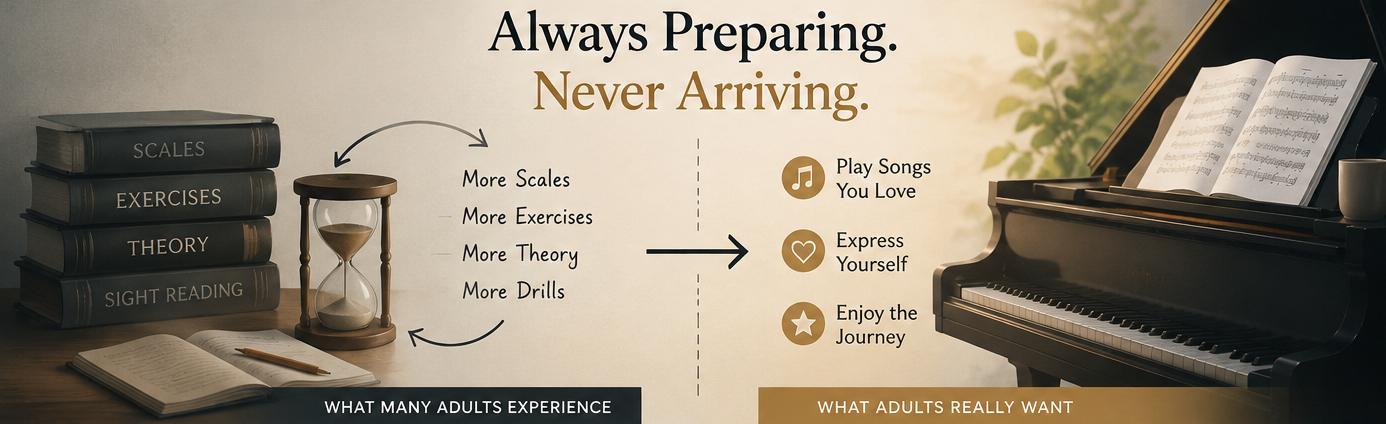
Imagine trying to learn a new language and spending the first six months memorizing grammar tables, verb conjugations, and sentence structures without ever having a real conversation. Most people wouldn't conclude that they were incapable of learning a language. They would conclude that the process felt disconnected from the reason they wanted to learn in the first place.
Learning piano as an adult often follows a similar path.
Most adult piano students don't wake up thinking, "I wish I knew more scales."
They want to play music they love. They want to sit at the piano and feel something recognizable emerge beneath their fingers. They want the experience of making music—not simply preparing to make music in the future.
Yet many piano lessons begin with preparation and postpone experience.
Students are often asked to trust that enjoyment will come later. Expression will come later. Real music will come later.
For some students, that works.
For many others, it doesn't.
And that is one of the biggest reasons adults quit piano.
Not because piano is too difficult.
Not because they lack discipline.
But because after months of effort, they still haven't touched the thing that inspired them to begin.
Interestingly, the adult students who make the fastest progress are not always the most talented.
More often, they are the students who experience music early. They learn songs they recognize. They discover patterns. They hear results. They begin connecting musical concepts to sounds they actually care about.
Once that happens, practice changes completely.
Instead of feeling like an obligation, it becomes a natural consequence of curiosity. Students practice because they want to return to the experience, not because they are forcing themselves through another assignment.
This doesn't mean that scales, technique, sight-reading, and music theory are unimportant.
They are incredibly important.
But timing matters.
Music theory becomes far more interesting when it explains something you've already heard. Scales become far more useful when they help you play music you already love. Technique becomes meaningful when it helps you express something you can already imagine.
The material itself isn't the problem.
Often, the sequence is.
And perhaps that's the distinction many adult piano students never hear.
Most people don't quit piano because it is hard.
They quit because after months of work, they still don't feel like musicians.
Those are two very different problems—and they require two very different solution
Related articles
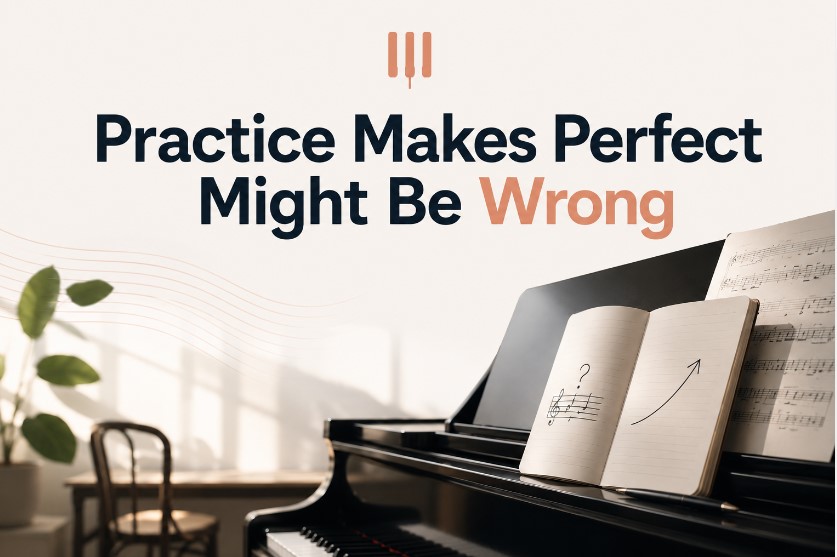
Practice Doesn't Make Perfect: Why Consistency Matters More in Music
Many musicians grow up believing that "practice makes perfect," but perfection is a moving target that can leave people feeling permanently unprepared. Music is less like an exam and more like a language: its purpose is communication, expression, and connection. The musicians who stay with music for life are often not those chasing perfection, but those who consistently return to their instrument--even for ten minutes a day--and allow music to become part of everyday life.
Administrator ·
Unlocking the Piano: Play Your Favorite Songs Faster Than Ever
Discover how adult piano learners can quickly play songs they love without years of practice or perfect technique.
Administrator ·
It's Never Too Late: Embrace Your Piano Journey with Sonatico
Discover how adults can learn piano at any age with Sonatico, breaking free from traditional methods and playing the music they love.
Administrator ·
Conversation
No comments yet. Start the conversation.
Join the conversation