
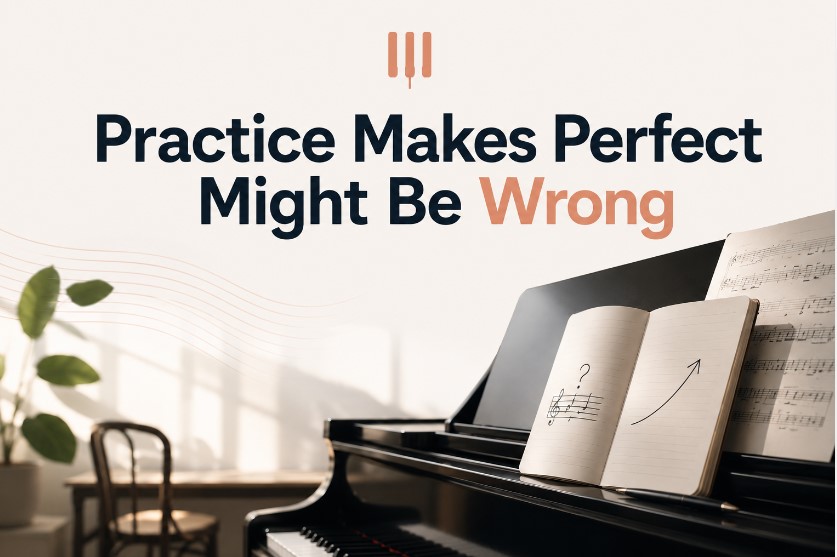
Practice Doesn't Make Perfect: Why Consistency Matters More in Music
Published
Many musicians grow up believing that "practice makes perfect," but perfection is a moving target that can leave people feeling permanently unprepared. Music is less like an exam and more like a language: its purpose is communication, expression, and connection. The musicians who stay with music for life are often not those chasing perfection, but those who consistently return to their instrument--even for ten minutes a day--and allow music to become part of everyday life.
🎹 Practice Doesn't Make Perfect
One of the most famous phrases in music education is also one of the most misleading:
Practice makes perfect.
Most of us have heard it since childhood. Teachers say it. Parents say it. Students repeat it to themselves whenever they feel guilty for not practicing enough.
For a long time, I believed it too.
But the longer I teach piano lessons and work with adult piano students, the more I wonder whether we've been aiming at the wrong target.
The problem isn't practice.
The problem is perfection.
✨ The problem isn't practice.
The problem is perfection.
Because hidden inside that phrase is an assumption that many musicians carry for years without realizing it.
That one day, after enough scales, enough exercises, enough mistakes, and enough years of work, we will finally become good enough to enjoy music.
As if music is waiting somewhere in the future.
As if one day we will arrive at a level where we can finally relax and call ourselves musicians.
But music doesn't happen in the future.
Music happens now.
🎵 Music doesn't happen in the future.
Music happens now.
It happens when a beginner struggles through a simple melody.
It happens when someone sits at the piano for ten minutes after work.
It happens when a student makes a mistake, laughs, and keeps playing.
It happens in imperfect performances, unfinished pieces, and awkward attempts.
Music is not the reward waiting at the end of the journey.
Music is the journey itself.
And I think many people quietly lose sight of that.
They spend years preparing for music instead of living it.
Always improving. Always correcting. Always getting ready. But never quite arriving.
Imagine treating language the same way.
Imagine deciding not to speak until your English became perfect.
Imagine refusing to have conversations until every sentence came out flawlessly.
Most of us would never learn to communicate at all.
Language is learned through use. Through mistakes. Through thousands of imperfect conversations that gradually become more natural over time.
Music works in much the same way.
💬 Music is not a test.
It is a conversation.
Its purpose is communication.
Nobody has a perfect conversation.
Nobody has a perfect friendship.
Nobody lives a perfect life.
Yet somehow we continue speaking, listening, connecting, and sharing ourselves with others.
Music deserves the same freedom.
The goal is not perfection.
The goal is relationship.
🎹 The goal is not perfection.
The goal is relationship.
A relationship with an instrument.
A relationship with sound.
A relationship with something that becomes part of your daily life rather than another task on a checklist.
This is why I often tell students something that sounds almost too simple:
⏱️ Ten minutes may be enough.
Not enough to master a concerto.
Not enough to transform your playing overnight.
But enough to keep the relationship alive.
Many people imagine musical progress as something dramatic. They picture long practice sessions, bursts of motivation, entire weekends devoted to improvement.
Yet most lifelong musicians are built differently.
They simply keep returning.
A few minutes before work.
Ten minutes after dinner.
A quiet moment at the piano before bed.
Individually, these moments seem insignificant.
But over years they become something powerful.
A person who plays for ten minutes every day for ten years develops something far more valuable than perfection.
📅 10 minutes today
📅 10 minutes tomorrow
📅 10 minutes next week
🎹 Eventually: a life that includes music.
They develop a life that includes music.
And that changes everything.
Because perfection is always moving away from us.
There will always be another piece to learn, another technique to refine, another weakness to fix.
Perfection asks for extraordinary effort.
Consistency asks only that you come back.
🌱 Consistency asks only that you come back.
And perhaps that is the real secret.
Not practicing harder.
Not becoming perfect.
Simply returning often enough that music slowly becomes part of who you are.
Perhaps the greatest musicians are not the ones who achieved perfection.
Perhaps they are the ones who never stopped having the conversation.
Because music is not a test to pass.
It is a language to speak.
And nobody waits for perfect language before joining a conversation.
Related articles
Why Adults Quit Piano (And Why It Has Nothing To Do With Talent)
Most adults who quit piano assume they lack talent, but the real problem is often the learning process itself. Many students spend months practicing scales, exercises, and theory without experiencing the thing that motivated them to start: making music. When students connect learning to real musical experiences early, motivation becomes natural and progress accelerates. The issue is rarely talent. More often, it's the order in which music is taught.
Amanda Sulivan ·
Unlocking Piano Mastery: Building Hand Coordination for Adult Beginners
Discover a new approach to piano learning that focuses on building hand coordination through strategic, step-by-step techniques.
Administrator ·
Mastering the Art of Piano: The Difference Between Playing and Practicing
Discover the crucial difference between playing and practicing piano to unlock your musical potential with strategic and focused practice.
Administrator ·
Conversation
No comments yet. Start the conversation.
Join the conversation