

How to Maintain Music Practice Habits During Summer Break
Published
Summer brings freedom, vacations, and changing schedules--but it can also make it easy for music practice to disappear completely. By creating a simple and realistic practice routine, students can continue making progress, retain skills, and return to lessons feeling confident instead of starting over each fall.
Why Summer Is the Most Important Time to Keep Practicing Music
Summer is finally here—or at least it is for most students and families. With summer comes a change in routine, more free time, vacations, camps, and often a little less structure than during the school year.
While summer is a wonderful time to relax, recharge, and enjoy the outdoors, it's also one of the easiest times for music practice to quietly disappear.
For music students, summer can actually be one of the best opportunities to make meaningful progress.
Music teachers spend a great deal of time thinking about what each student should be working on and creating assignments that support their growth. To get the most out of music lessons, it's helpful to schedule practice time just like you schedule lesson time.
The goal doesn't have to be perfection.
Let's say you schedule five practice sessions each week.
Will you make all five every week?
Probably not.
A friend might invite you to the river. There may be a family barbecue, a baseball tournament, a day trip, or simply one of those beautiful summer evenings when other plans take priority.
That's completely normal.
But if you've planned five practice sessions and end up completing three, you're still making progress. If nothing is scheduled at all, it's much easier for practice to become zero sessions instead of three.
Consistency matters far more than intensity.
The best practice schedule is the one that fits naturally into your day.
Maybe it's after lunch.
Maybe it's before dinner.
Maybe it's first thing in the morning.
Or perhaps your family uses the same strategy many parents have used for generations:
"No TV—or screen time—until you've practiced!"
Whatever time works best for you or your student, try to make it part of the daily routine. Calendar reminders, phone alarms, and simple habit trackers can make a surprisingly big difference.
Summer doesn't have to mean putting music on hold.
Even a few short practice sessions each week can help students maintain their skills, build confidence, and return to lessons in the fall ready to move forward instead of spending weeks catching up.
And that may be exactly what the doctor—or perhaps the music teacher—ordered.
Related articles
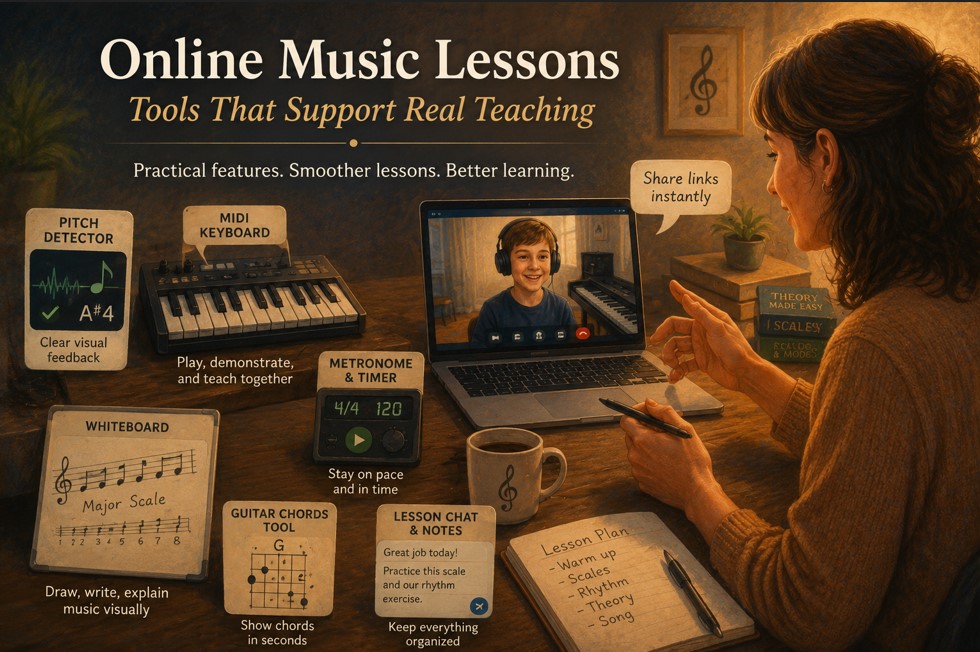
Music Teaching Tools That Actually Support the Lesson
Effective online music teaching depends not only on video calls, but on the tools surrounding the lesson itself. Integrated workflows such as MIDI keyboard support, pitch detection, metronomes, whiteboards, lesson chat, and music theory tools help teachers reduce friction and create a more natural teaching environment online.
Collin Braley ·
Conversation
No comments yet. Start the conversation.
Join the conversation