
Music Teaching Tools That Actually Support the Lesson
Published · Updated
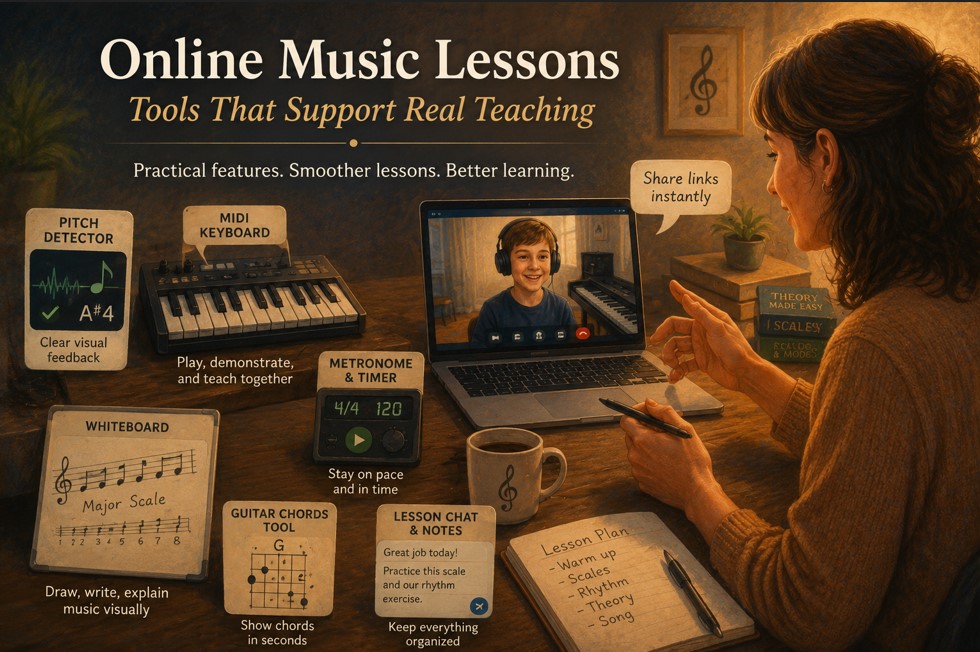
Effective online music teaching depends not only on video calls, but on the tools surrounding the lesson itself. Integrated workflows such as MIDI keyboard support, pitch detection, metronomes, whiteboards, lesson chat, and music theory tools help teachers reduce friction and create a more natural teaching environment online.
Exploring practical workflows for online music lessons
One of the biggest challenges in online music lessons is not the lesson itself -- it's everything surrounding it.
Teachers often move between different apps, links, files, metronomes, PDFs, videos, and chat windows just to recreate what would naturally happen in a physical studio. Over time, this fragmentation quietly affects the flow of teaching.
That is why many music educators are beginning to look not only at video quality, but at the overall teaching environment.
When first exploring Sonatico, what stands out is not one dramatic feature, but the collection of small workflow tools that help lessons move more naturally.
Some are simple. Some are highly practical. But together, they reduce friction during teaching.
For example, teachers can connect a MIDI keyboard directly into the lesson environment and use it for demonstrations, theory explanations, intervals, or harmony work. Instead of switching software, the keyboard becomes part of the lesson itself.
There are also smaller features that become surprisingly important in daily teaching:
- quickly sharing YouTube or Google Drive links
- built-in lesson chat and notes
- a visual metronome
- timers for lesson pacing
- whiteboard tools for drawing or explaining musical ideas
These are not flashy additions, but practical teaching supports that reduce interruptions.
Some tools are especially useful for ear training and beginner instruction.
A pitch detector can help identify tuning issues, interval accuracy, or vocal pitch problems in real time. Guitar teachers can quickly display chord shapes without searching for external images or diagrams. And for teachers traveling or teaching away from an instrument, an on-screen piano can still be used to demonstrate melodies and harmonies during the lesson.
What becomes noticeable over time is not simply the number of features, but the way they support continuity.
Instead of forcing teachers to adapt to generic meeting software, the environment begins to adapt to music teaching itself.
And that changes the feeling of the lesson.
Many teachers already know how to teach online.
The real question is whether the tools around the lesson actually support the way music is taught.
Sometimes the most valuable technology is not the one that adds complexity -- but the one that quietly removes friction.
What this supports
- online music teaching workflows
- music lesson tools for teachers
- MIDI keyboard integration for lessons
- ear training and pitch detection
- music theory teaching online
- interactive online music lessons
- reducing friction in online teaching
Related articles
Practice Doesn't Make Perfect: Why Consistency Matters More in Music
Many musicians grow up believing that "practice makes perfect," but perfection is a moving target that can leave people feeling permanently unprepared. Music is less like an exam and more like a language: its purpose is communication, expression, and connection. The musicians who stay with music for life are often not those chasing perfection, but those who consistently return to their instrument--even for ten minutes a day--and allow music to become part of everyday life.
Administrator ·
Why Adults Quit Piano (And Why It Has Nothing To Do With Talent)
Most adults who quit piano assume they lack talent, but the real problem is often the learning process itself. Many students spend months practicing scales, exercises, and theory without experiencing the thing that motivated them to start: making music. When students connect learning to real musical experiences early, motivation becomes natural and progress accelerates. The issue is rarely talent. More often, it's the order in which music is taught.
Amanda Sulivan ·
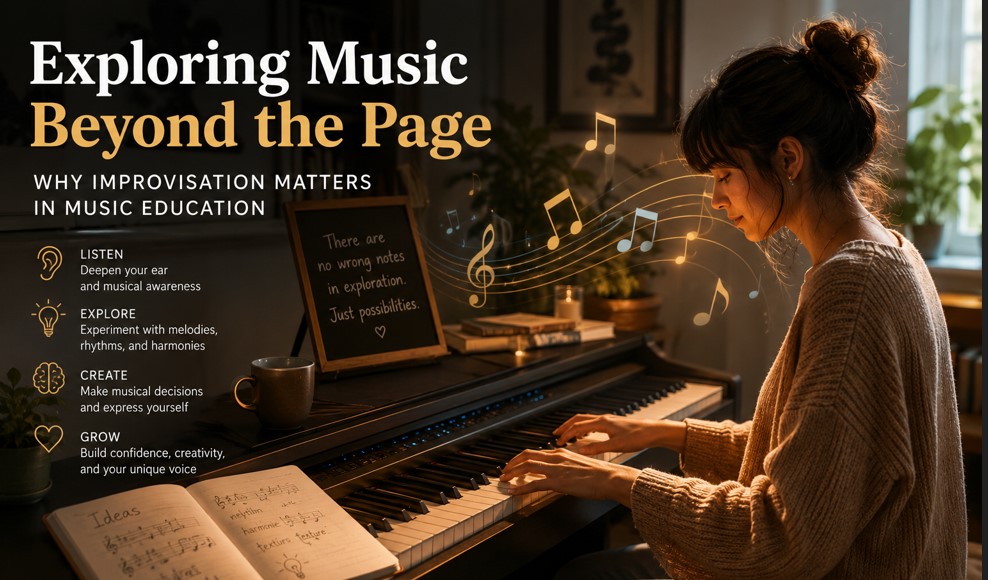
Exploring Music Beyond the Page
Improvisation encourages musicians to move beyond notation and explore sound creatively through listening, experimentation, and spontaneous musical decision-making. Alongside technique, repertoire, and music theory, creative exploration helps develop ear training, confidence, musical intuition, and a deeper personal connection to music.
John Lettieri ·
Conversation (1)
Join the conversationMegumi
As a composer, I spend enough time solving musical problems — I don't want to spend lesson time solving technical ones too. What I appreciate most about integrated teaching tools is not any single feature, but how they help the lesson flow naturally and keep the focus where it belongs: on making music.