
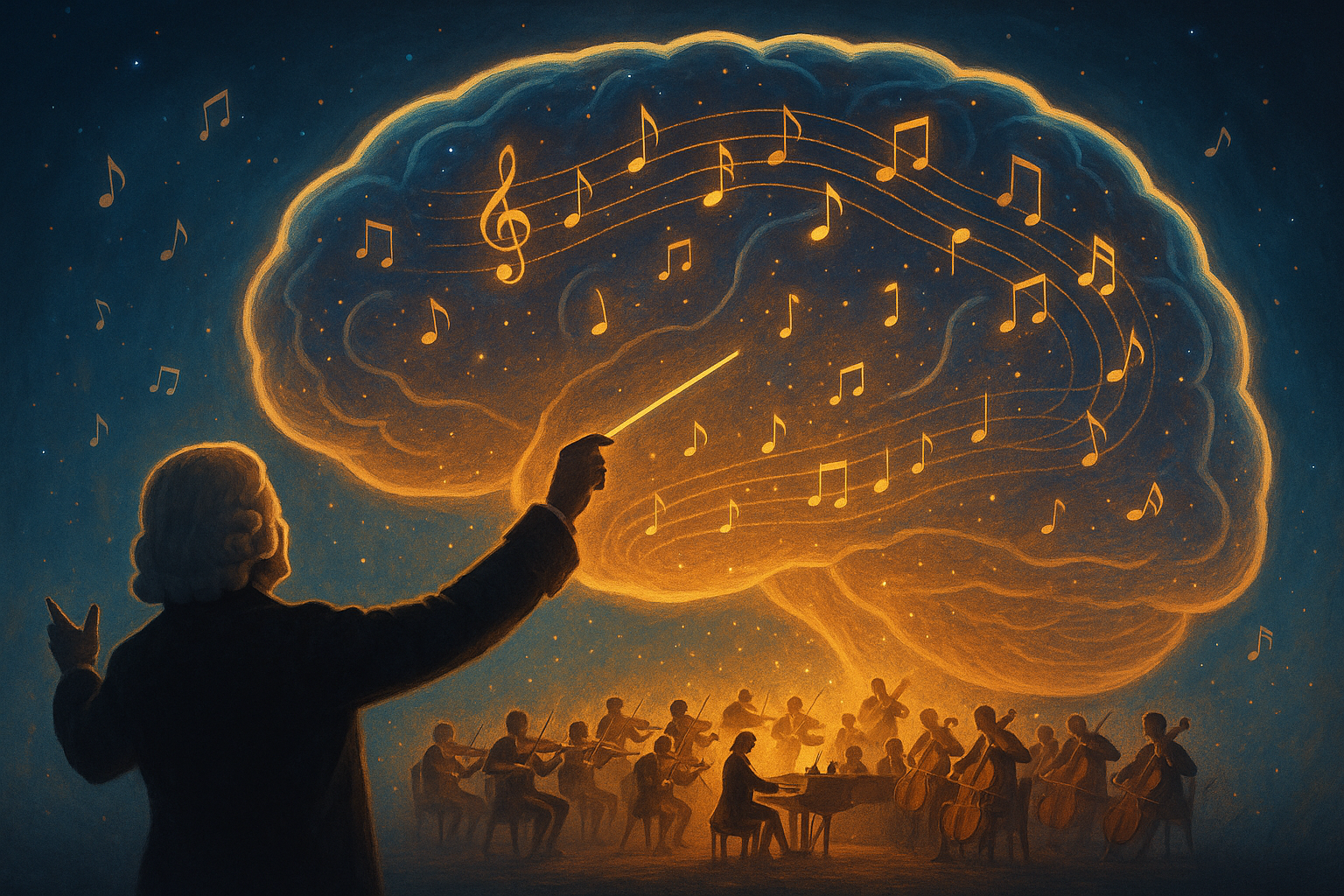
Your Brain: The Hidden Composer -- 5 Neuroscience Secrets Every Musician Should Know
Published
Discover how your brain doesn't just hear music -- it creates it. From your built-in "mute button" to the way you fill in missing notes, modern neuroscience reveals what J.S. Bach always knew: listening is an art of the mind. This poetic science piece explores five fascinating facts about how musicians think, focus, and hear -- proving the brain is the most complex instrument ever designed.
🎶 Your Brain Is the Ultimate Musical Instrument
by J.S. Bach
Ah, how curious this age is!
Machines can play every note, and yet they still cannot listen.
For true music is not heard by the ear alone -- it is built, shaped, and gloriously completed by the brain.
Let us consider, then, what a magnificent instrument this mind of yours is.
1️⃣ Your Brain Has a "Mute" Button
When the orchestra thunders and the flutist still hears her own part -- that is no miracle of volume, but of focus.
The mind itself chooses what to hear and what to hush.
Listening, my friends, is not passive. It is performance.
2️⃣ Your Ears Never Sleep
Even in silence, the musician hears.
This is audiation -- the art of sounding within.
When you read a score and the notes begin to sing in your imagination, that is the sleepless ear of the brain, rehearsing eternity.
3️⃣ The "Danger!" Response to Sound
You wince at the shriek of a wrong note or the scrape of chalk -- and rightly so!
Your ancient brain still guards you.
The amygdala, ever watchful, flares like a candle against dissonance.
Once it warned of beasts; now it warns of bad intonation.
4️⃣ You Hear with Your Brain, Not Just Your Ears
The ear gathers air; the temporal lobe creates meaning.
That is why one hears noise while another hears harmony.
You have trained your neurons to sing together -- each synapse a string in the divine continuo.
5️⃣ Your Brain Fills in the Musical Blanks
When a cough steals a note, your mind supplies it without effort.
This foresight is the secret of rhythm and reading --
not reaction, but anticipation.
Music lives not in what you hear, but in what your brain expects to hear next.
So remember this, dear students and teachers:
when you teach, you are not shaping fingers -- you are shaping minds.
When you listen, you are not receiving sound -- you are completing creation itself.
🎩 The brain composes. The soul conducts.
💫 Think in music. Live in harmony.
Related articles
The Well-Tempered Mistake
Written as a letter from Bach to the present day, this piece reflects on tuning, compromise, and the moment music chose convenience over resonance. It asks a simple but unsettling question: what if sound was never meant to be fixed -- and healing begins where notes dissolve into vibration?
Johann Sebastian Bach ·
Conversation
No comments yet. Start the conversation.
Join the conversation