
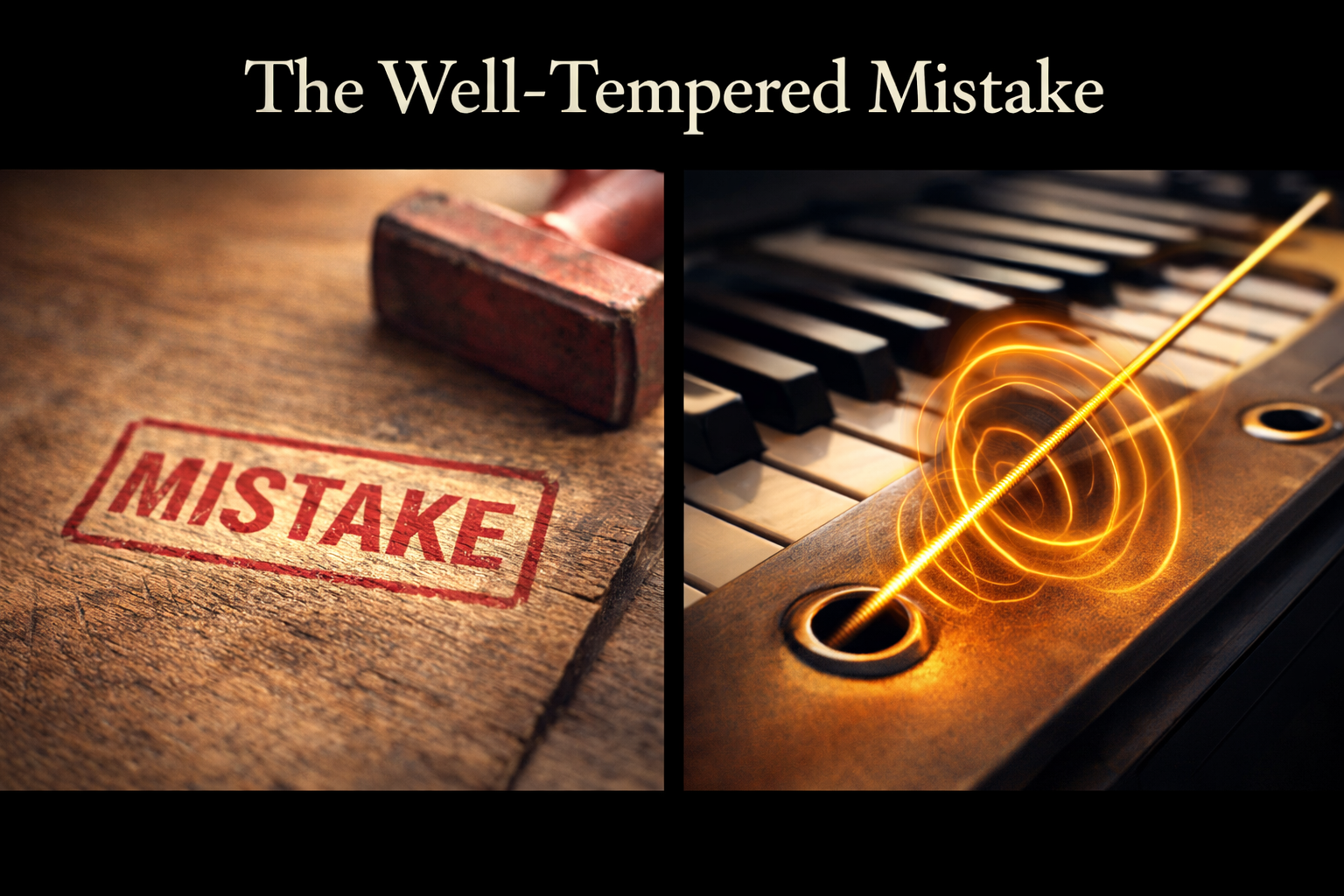
The Well-Tempered Mistake
Published
Written as a letter from Bach to the present day, this piece reflects on tuning, compromise, and the moment music chose convenience over resonance. It asks a simple but unsettling question: what if sound was never meant to be fixed -- and healing begins where notes dissolve into vibration?
I lived my life in search of order. And yet, looking back from a distance today, I would call one of my most celebrated works a mistake. The Well-Tempered Clavier was a compromise -- a refined one, a necessary one, perhaps even an inevitable one. I agreed to sacrifice purity for convenience, precision for universality, so that music could travel freely through all tonalities without resistance from the instrument or rebellion from the performer's ear.
But every compromise quietly redirects the path. Music gradually withdrew into the realm of diatonic thinking. Seven notes began to appear as a natural law. Tuning felt complete, settled, resolved. Listening itself became something to be adjusted, rather than something to be cultivated.
And yet nature has never known seven notes. Air vibrates continuously. Sound does not move in steps -- it flows. It thickens, dissolves, and enters into resonance with the human body, with breath, with the inner rhythm that exists before any theory is formed. If I were composing today, I would not be concerned with expanding tonalities. I would be searching for a scale that does not instruct, but heals.
Not one that corrects emotion, but one that restores balance. A scale where tones are not fixed points, but events -- emerging precisely where the air itself begins to respond. A music that does not impose structure upon sound, but listens for structure already present within it.
I would seek a tuning that is not dictated to the instrument, but arises between the source of sound and the listener. A vibration that passes through the body rather than stopping at the intellect.
Perhaps such a scale does not consist of seven notes.
Perhaps not of twelve.
Perhaps it does not consist of numbers at all.
It may not be a musical system, but a state of alignment -- alignment of space, of air, of the human being within sound.
And if there exists a sound structure that coincides with the rhythm of the universe itself, it requires no proof. It is recognized -- physically.
The Well-Tempered Clavier granted music the freedom to move. But perhaps it led us away from the freedom to resonate.
And if today a composer once again searches for a scale capable of restoring wholeness, I would listen with great attention -- not as to a revolutionary, but as to someone who has finally heard what has always existed between the notes.
J. S. Bach
imagined -- in the 21st century
Related articles
Your Brain: The Hidden Composer -- 5 Neuroscience Secrets Every Musician Should Know
Discover how your brain doesn't just hear music -- it creates it. From your built-in "mute button" to the way you fill in missing notes, modern neuroscience reveals what J.S. Bach always knew: listening is an art of the mind. This poetic science piece explores five fascinating facts about how musicians think, focus, and hear -- proving the brain is the most complex instrument ever designed.
Johann Sebastian Bach ·

Conversation
No comments yet. Start the conversation.
Join the conversation