
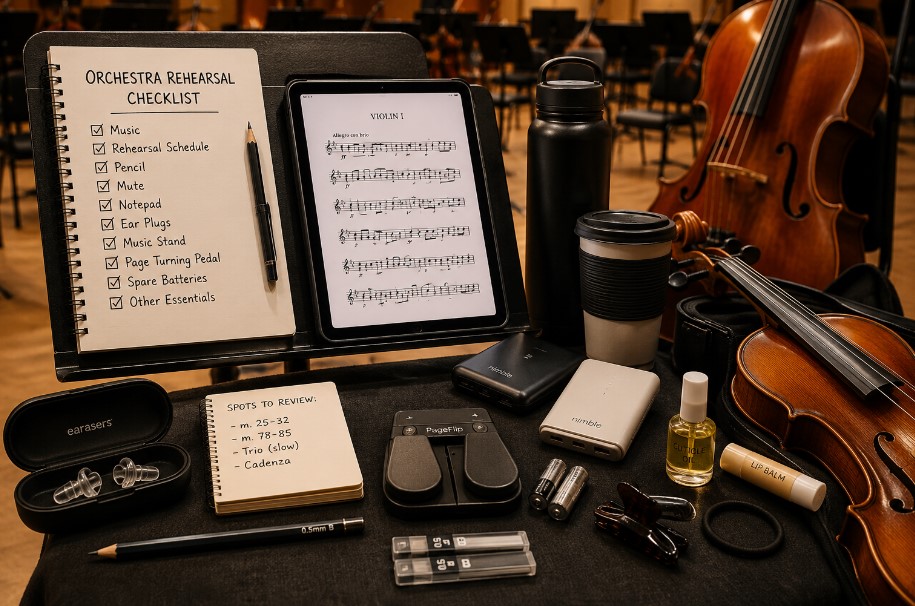
Orchestra Rehearsal Guide, Part I: What should I bring to rehearsal?
Published · Updated
Most of my students started playing in orchestra classes, but some of them don't have orchestra classes available at their middle schools. When they join the high school orchestra, they're entering an established social group, often with inferred rules. I thought this information might be helpful for other young students as well.
General Notes
Preparation is highly valued in an orchestral setting—not only having practiced the music, but also having all the tools you might need. Being prepared will allow you to present yourself as a true professional. Professionalism includes flexibility, the ability to adapt to difficult situations with a calm demeanor.
I will include my favorite products in this guide. I'm not endorsed or sponsored; these are my genuine recommendations.
Music
This sounds silly at first, but the music is worth including on the list because having it in some form is absolutely necessary. For string players, the outside player is usually responsible for the original parts. However, even if you're assigned to the inside part, I strongly recommend having your own copies of the music at rehearsal. Seating decisions can change or players might be absent unexpectedly (this has happened to me at least once for almost every concert season). If I'm using my iPad, I still keep physical copies because my iPad has failed on occasion. If the forScore app crashes or my iPad runs out of battery, I can transition to my backup copies seamlessly.
Rehearsal Schedule
This is the item I'm most likely to forget... I've admittedly peeked over the top of my stand to check what we're playing more times than I can count. Having the rehearsal schedule printed (or easily accessible on a silenced device) looks much more professional.
Pencil
Typically, the inside player is responsible for bringing a pencil and the outside player is responsible for marking the music. I keep a mechanical pencil in the outer pouch of my violin case at all times, even though I mostly use my iPad, because it's extremely easy to have a spare. On occasion, my stand partner has a bad pencil and we used mine instead. My favorite pencil lead is 0.5mm B, which is a bit thinner and softer than standard pencil lead (0.7mm HB). The lines are dark, crisp, and easy to erase from the originals after the concert. I also keep additional pen tips in my purse; since they're small, they're incredibly easy to keep with me at all times. I've had my pen tip break during rehearsal (I might've dropped my Apple Pencil) and struggled to keep up while "finger painting" on my music.
Orchestral Mute
For one of the first professional concert cycles I played in, I lost my mute. I felt anxious about it for the whole concert. Now I check that I have a mute before I leave the house.
Small Notepad
I learned this from a colleague. She would write all the difficult spots she wanted to review on a small notepad that was easy to keep on the music stand or under her chair. I had been marking the margins of the music, but when I saw that she had all the notes in one spot, I couldn't believe I had never thought bring a notepad myself. My practicing became much more efficient once I knew where to find difficult spots and could plan and prioritize based on my notes.
Ear Plugs
I didn't protect my ears when I was a student and I didn't realize how loud the orchestral environment can be until I had an Apple Watch (which produces decibel warnings whenever it senses an environment at or above 80 db). I consider them an absolute essential now. I can hear myself and my section with greater clarity and my ears fatigue much less during rehearsal. My current favorite ear plugs are Earasers, though I also wear Loop Switch ear plugs if I want to have more protection in one of my ears, most likely the one facing the back of the stage (winds/brass/percussion). They are not very expensive, especially considering the great benefit they provide to the musician. Once hearing damage occurs, it's irreversible.
Music Stand
Even when stands are provided or my stand partner is bringing the music stand, I usually bring an extra (even if I'm leaving it in my car). If the provided stand isn't satisfactory, I can easily use my own. Sometimes I bring one for keeping my iPad on stage so I can mark my own music easily, even if my stand partner and I plan to use the original music at the concert. I use a KraftGeek Capsule music stand. It's just a bit larger than my water bottle. The stand light for the Capsule is also excellent.
Bluetooth Page Turning Pedal
Whenever I'm using my iPad, I really like to use my PageFlip Firefy or Butterfly. I don't have to stop playing to flip pages and I can navigate much more quickly and easily with a pedal.
Spare Batteries
I like to have a Nimble Champ Lite portable charger that fits on my stand, a Nimble Wally charger for refreshing my iPad during breaks, and PaleBlue rechargeable batteries for my page turning pedal. I also like to charge the AA batteries on my way to rehearsal so I know they're reliable.
Other Accessories
I like to have a shawl in case the venue is cold or drafty, a hair clip or tie, a water bottle, a warm beverage (coffee/tea/ broth), cuticle oil, and lip balm with me. If I'm uncomfortable, I'm not able to give my full attention to the rehearsal.
What Should I Do if I Forget Something?
Even if you prepare to the best of your ability, mistakes happen. How you handle a bad situation can leave a lasting impression or even a reputation. I brought the music for the wrong orchestra to a rehearsal once. I told the personnel manager, she gave me her iPad and pedal, and the rehearsal went relatively smoothly. My stand partner, who was not at fault for this mistake, did not handle the situation gracefully; she yelled at me and refused to sit with me. I stayed on the substitute list, while my stand partner did not. What I learned from this was that being easy to work with is critical. My stand partner was a better, more experienced player than I was, but she was not someone I looked forward to playing with. Having a good attitude, being generous and honest, and acting in the best interest of the group will go further than pure technique or playing experience will. If you give the ensemble your best, your effort will be noticed and appreciated.
Related articles
From Practice Room to Tour Van: What Playing the Violin in a Rock Band Taught Me
A reflection on how performing with the rock band "Would You Kindly?" and engaging with local music communities revealed gaps in my traditional classical training. Broader musical exposure can better prepare students for diverse professional paths.
Megan Weaver ·
Conversation
No comments yet. Start the conversation.
Join the conversation