
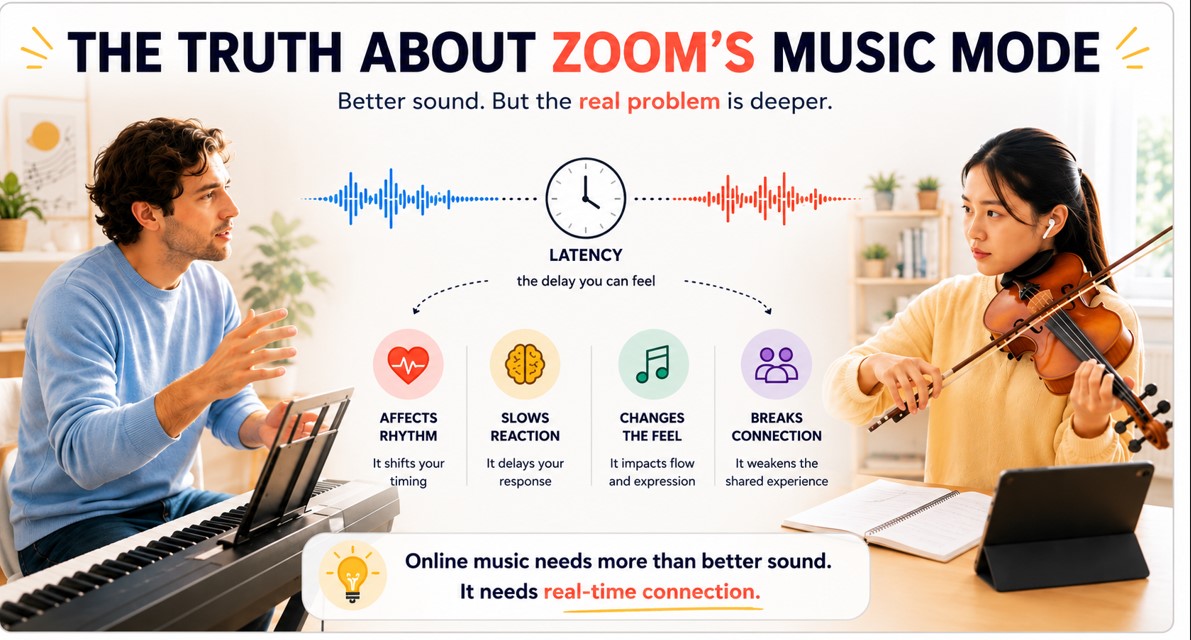
The Truth About Zoom's Music Mode
Published · Updated
Most musicians are told that turning on "Music Mode" in Zoom solves the problem of online music teaching. But Music Mode is not really a new technology built for music. In many ways, it simply reduces some of the speech-processing systems Zoom originally created for conversations. That may make music sound more natural -- but it does not solve the bigger issue: latency. And for musicians, latency affects far more than just "sync." It changes timing, reaction, phrasing, and the overall feeling of interaction between teacher and student. This article explores why online music still feels unnatural on general communication platforms -- and why reducing musical latency is a very different challenge from improving speech calls.
When musicians first begin teaching online, almost everyone quickly hears the same advice:
"Just turn on Music Mode in Zoom."
And suddenly it feels like the problem has already been solved. As if Zoom has some hidden professional technology designed specifically for musicians -- you just need to find the right checkbox. But in reality, things are much more complicated.
Zoom was not built for music. It was built for conversation. For meetings, calls, online discussions where people interrupt each other, laugh at the same time, where there is street noise, typing sounds, or an air conditioner running in the background. And to be fair, Zoom became extremely good at that.
Modern communication platforms have learned how to almost "repair" human speech in real time.
The system constantly analyzes audio and decides:
what is voice,
what is noise,
what can be reduced,
what should be removed to make conversation cleaner and easier to understand.
That is why normal video calls today often feel so "clean."
But music is not speech.
For musicians, the endings of notes matter. The resonance of a piano after a chord. The breath before a phrase. The subtle vibration of a string after a note. The natural dynamics of an instrument.
And a system designed to improve conversation often treats some of these musical details as unnecessary noise.
That is when musicians begin to notice a feeling that almost every online music teacher recognizes:
the sound constantly seems to "open" and "close," the endings of notes disappear, the instrument starts sounding flat, and the music loses its sense of natural space.
This becomes especially noticeable during online music lessons with piano, strings, choir, and any kind of music where acoustic detail matters.
And then comes the famous button -- Music Mode.
And many people naturally assume:
"Finally. Zoom created something specifically for musicians."
But there is an interesting paradox here.
Music Mode is not so much a new music technology as it is a partial step backwards.
Over the years, Zoom and similar platforms kept improving speech communication. More processing, more noise suppression, more "smart" algorithms designed to make conversations smoother and cleaner. But those same improvements also started damaging music. So Music Mode mostly disables some of the modern speech-processing systems.
In other words, the feature looks like a new music innovation, while in reality it often simply returns the sound closer to an older, less processed state -- before many of the "smart" speech enhancements were introduced.
The system simply interferes with the musical signal less aggressively.
Less cutting.
Less cleaning.
And musicians start thinking:
"Oh... finally this sounds more natural."
But another major problem still remains: latency.
When music feels "out of sync," many people immediately think about synchronization, but that is not exactly the same thing.
Latency is the delay between the moment one person produces a sound and the moment the other person hears it.
And latency is often what makes an online music lesson feel unnatural for musicians and teachers.
Even if the teacher and student are not trying to play together at the same time, delay still affects rhythm, reaction, phrasing, and the overall feeling of musical interaction.
And true fully synchronized online playing with video -- where two people can genuinely play together and feel the same musical timing simultaneously -- is still practically impossible today under normal internet conditions.
And this is the important point:
Zoom was never really moving toward reducing musical latency, because its main goal was different -- making conversations stable, clear, and comfortable.
That is why Music Mode mainly solves the problem of "cut" sound, not the problem of delay itself.
So the music may sound a little more natural, but the overall system is still fundamentally designed around speech rather than musical interaction.
And this is where the paths begin to separate between general communication platforms and systems trying to work specifically for music.
At Sonatico, we are approaching this from a different direction. Not by asking how to improve speech. But by asking how to preserve the feeling of musical interaction.
How not to "cut away" the sound. How to preserve the natural dynamics of an instrument. And how to reduce latency specifically for musical interaction -- not just for comfortable conversation. Not perfectly. Not magically. But in the direction of music rather than just meetings. Because for musicians, it is not only the sound itself that matters. It is the feeling of shared time between people.
Related articles
Why Motivation Keeps Failing You
Motivation gets you started, but discipline is what turns goals into real results. Discover why lasting success in music, sports, health, business, and everyday life depends far more on consistent discipline than on temporary motivation.
Paul Mark ·
What Keeps a Musical Community Alive?
A reflection on the history of the Yukon Registered Music Teachers' Association and the people, relationships, and shared commitment that help musical communities endure across generations.
Administrator ·
Practice Doesn't Make Perfect: Why Consistency Matters More in Music
Many musicians grow up believing that "practice makes perfect," but perfection is a moving target that can leave people feeling permanently unprepared. Music is less like an exam and more like a language: its purpose is communication, expression, and connection. The musicians who stay with music for life are often not those chasing perfection, but those who consistently return to their instrument--even for ten minutes a day--and allow music to become part of everyday life.
Administrator ·
Conversation
No comments yet. Start the conversation.
Join the conversation