
Why Motivation Keeps Failing You
Published
Motivation gets you started, but discipline is what turns goals into real results. Discover why lasting success in music, sports, health, business, and everyday life depends far more on consistent discipline than on temporary motivation.
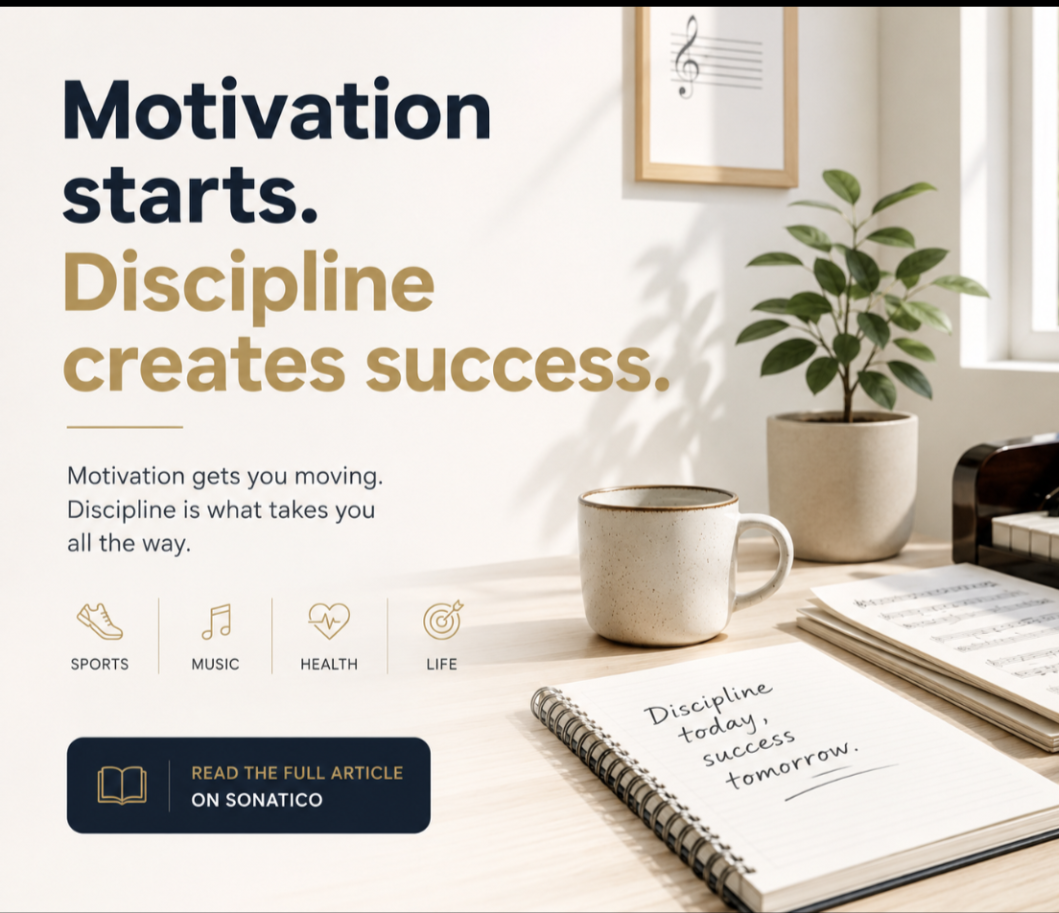
Motivation Starts. Discipline Creates Success.
We hear a lot about motivation these days. It often seems like motivation is the secret behind every successful person.
And to some extent, that's true.
Without motivation, most of us would never even take the first step. It's what makes us say, "I want to change my life." It's what gets us to join a gym, learn a new language, pick up a musical instrument, eat healthier, or start a new business.
But this is where many people make a mistake.
They believe motivation will carry them all the way to success.
It won't.
Motivation is meant to start the journey, not finish it. It gives you the initial push, but it isn't built to last. It fades. Sometimes it comes back, then fades again. That's simply its nature.
If your progress depends on feeling motivated, your progress will stop every time motivation disappears.
That's why, after the first step, something else has to take over.
That something is discipline.
From that moment on, your future is no longer determined by motivation.
You can debate talent, luck, opportunities, or even the best strategy. But long-term success is built on one thing more than anything else: discipline.
Look at sports.
No athlete becomes a champion because they wake up inspired every morning. Champions are made by showing up to train when they're tired, when they don't feel like it, when no one is watching, and when quitting would be easier.
Music is no different.
The only difference is that people don't always see the work behind the performance. Every beautiful concert is built on thousands of hours of scales, repetition, slow practice, corrections, and persistence. Great musicians aren't made by inspiration. They're made by discipline.
The same is true of your health.
No one becomes healthy or fit because of one powerful moment of motivation. It happens through hundreds of ordinary decisions—choosing the healthier meal, going for a walk, showing up for a workout, getting enough sleep. Those small decisions, repeated day after day, create extraordinary results.
The same principle applies to business, learning, relationships, languages, and almost every meaningful goal in life.
Your success will never be determined by how motivated you were on day one.
It will be determined by whether you kept going after that motivation was gone.
And that's actually good news.
You don't have to spend your life chasing inspiration.
You don't have to wake up every morning feeling excited.
You need discipline.
Discipline is what turns success from an idea into a reality.
Motivation opens the door.
Discipline is what walks you through it.
Related articles
What Keeps a Musical Community Alive?
A reflection on the history of the Yukon Registered Music Teachers' Association and the people, relationships, and shared commitment that help musical communities endure across generations.
Administrator ·
Practice Doesn't Make Perfect: Why Consistency Matters More in Music
Many musicians grow up believing that "practice makes perfect," but perfection is a moving target that can leave people feeling permanently unprepared. Music is less like an exam and more like a language: its purpose is communication, expression, and connection. The musicians who stay with music for life are often not those chasing perfection, but those who consistently return to their instrument--even for ten minutes a day--and allow music to become part of everyday life.
Administrator ·
The Truth About Zoom's Music Mode
Most musicians are told that turning on "Music Mode" in Zoom solves the problem of online music teaching. But Music Mode is not really a new technology built for music. In many ways, it simply reduces some of the speech-processing systems Zoom originally created for conversations. That may make music sound more natural -- but it does not solve the bigger issue: latency. And for musicians, latency affects far more than just "sync." It changes timing, reaction, phrasing, and the overall feeling of interaction between teacher and student. This article explores why online music still feels unnatural on general communication platforms -- and why reducing musical latency is a very different challenge from improving speech calls.
Administrator ·


Conversation
No comments yet. Start the conversation.
Join the conversation