
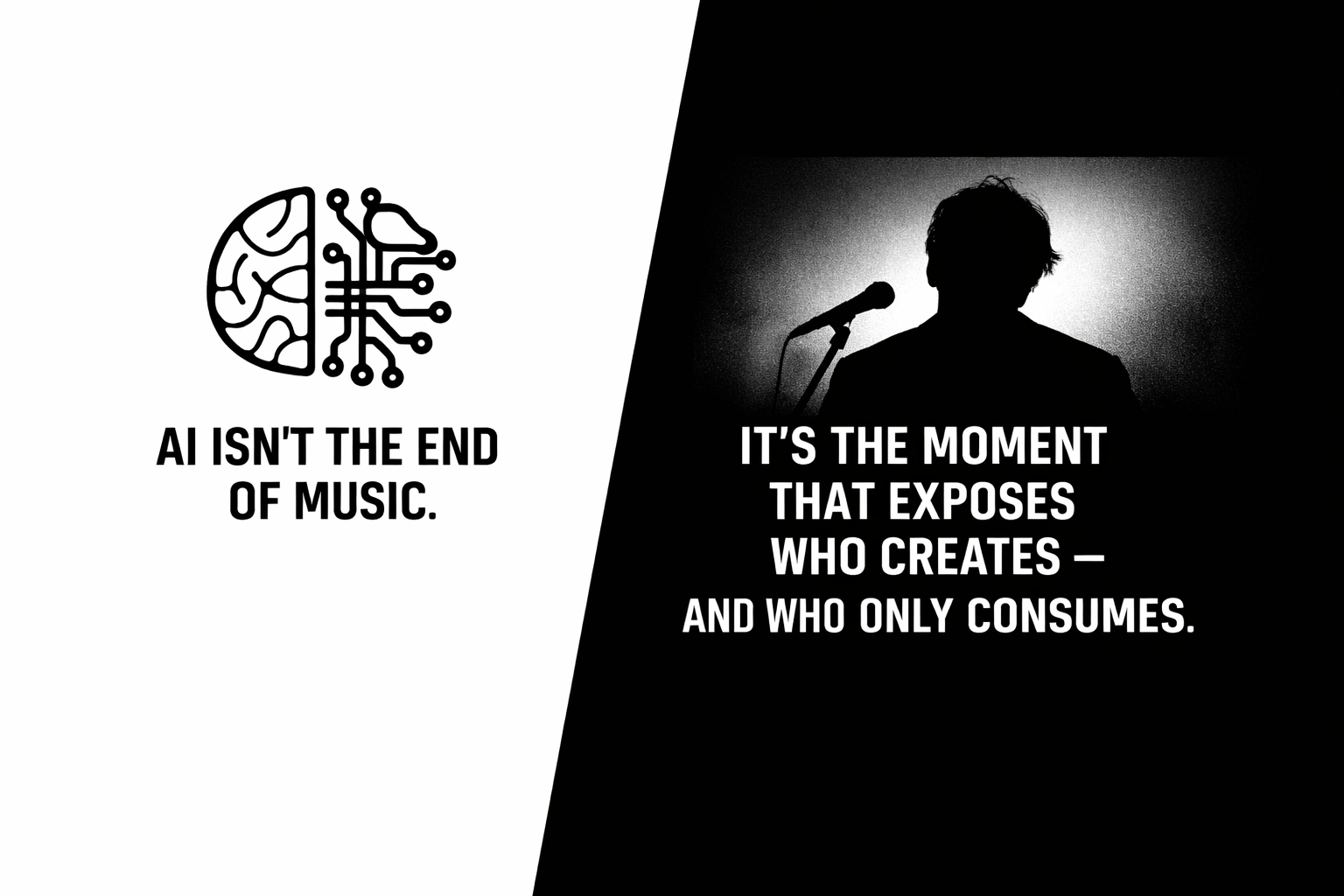
AI isn't the end of music. It's the moment that exposes who creates -- and who only consumes.
Published
Everyone is afraid that AI will replace musicians. The real fear is aimed in the wrong direction.
Why Musicians Shouldn't Be Afraid of AI
Many people today are worried about AI writing music.
The conclusion often sounds dramatic: "There's no point in learning music anymore -- AI will do everything."
This fear is based on a misunderstanding.
In reality, there have always been two distinct groups of people: consumers and creators.
Consumers listen, watch, and consume finished results. They always have. AI will not turn them into creators -- if anything, it will give them even more content to passively consume.
Creators, on the other hand, work differently. For them, AI is not a replacement but a tool.
Real musicians don't "consume AI" to think less or to imitate. They use it to save time, remove routine, test ideas faster, and give clearer instructions. They work with AI, not instead of themselves.
AI doesn't think. It reacts to the quality of the task it's given.
Which means the better the musician's thinking, the more useful AI becomes.
Why Composers Have Nothing to Fear
Real composers have never written to demand. Their music was never created because "the market needs this."
They wrote because they couldn't not write -- regardless of taste, expectations, or audience size.
That's why the fear that AI will "kill demand" for composers' music misses the point.
There has never really been demand in the market sense to begin with.
Composers' music has always existed -- and will continue to exist -- not because it is ordered, but because it is created.
Why Performers Shouldn't Worry Either
AI does not represent real value for listeners. Not because it is "bad," but because everyone understands it is artificial.
The value of music is not only in sound, but in the presence of a real human being: breath, risk, imperfection, and the moment itself.
A live performance by a human musician is an event. AI is a file. No level of technical perfection can replace the experience of a real person on stage.
Related articles
Why Motivation Keeps Failing You
Motivation gets you started, but discipline is what turns goals into real results. Discover why lasting success in music, sports, health, business, and everyday life depends far more on consistent discipline than on temporary motivation.
Paul Mark ·
What Keeps a Musical Community Alive?
A reflection on the history of the Yukon Registered Music Teachers' Association and the people, relationships, and shared commitment that help musical communities endure across generations.
Administrator ·
Practice Doesn't Make Perfect: Why Consistency Matters More in Music
Many musicians grow up believing that "practice makes perfect," but perfection is a moving target that can leave people feeling permanently unprepared. Music is less like an exam and more like a language: its purpose is communication, expression, and connection. The musicians who stay with music for life are often not those chasing perfection, but those who consistently return to their instrument--even for ten minutes a day--and allow music to become part of everyday life.
Administrator ·
Conversation
No comments yet. Start the conversation.
Join the conversation