
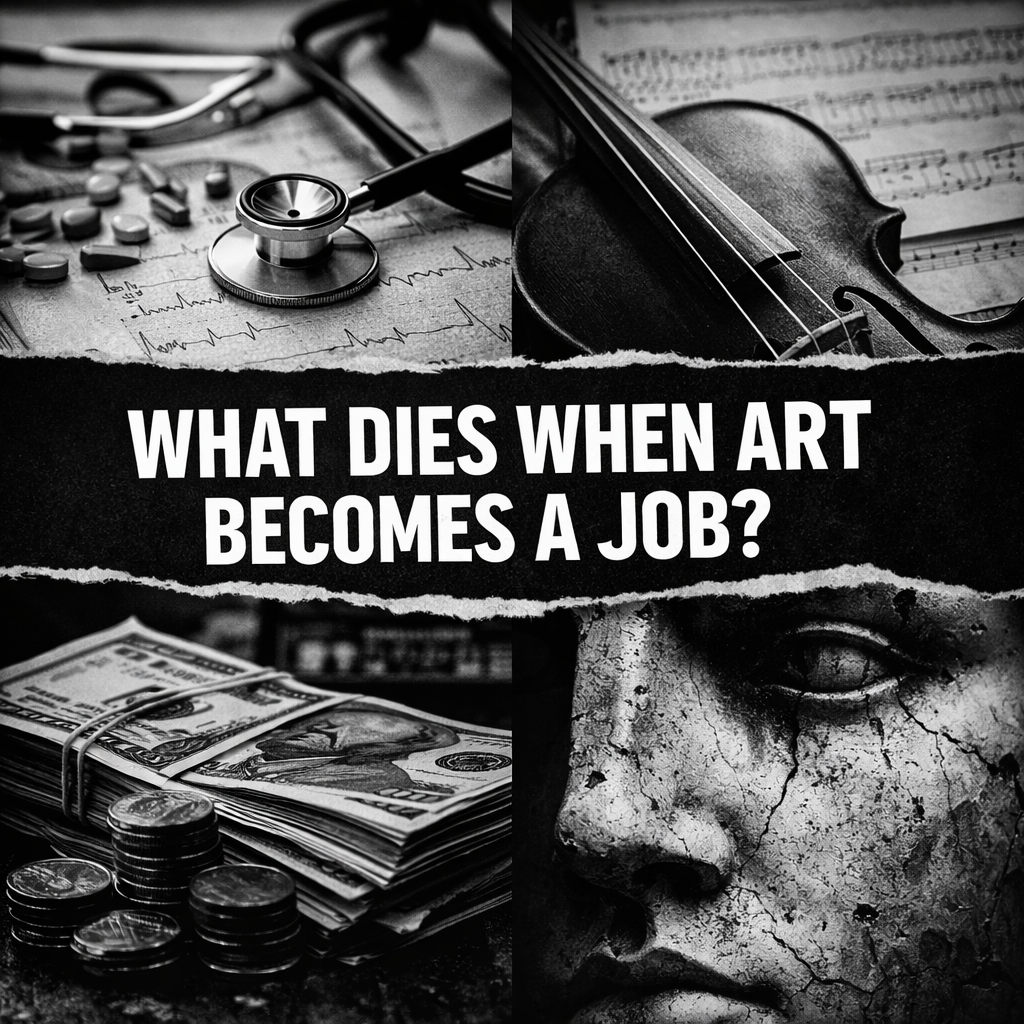
What Dies When Art Becomes a Job?
Published
A profession earns money as long as problems exist. If everyone were permanently healthy, the system would collapse. This isn't about bad people. It's about a system that needs problems to survive. Music works the same way. The moment music becomes a profession, it stops serving music and starts serving income and self-preservation. Not composition from inner necessity. Composition designed to earn more. Some things, by their nature, cannot be professions without losing their soul. The question isn't how to monetize art. The question is what dies when you do.
Not Everything That Makes Money Should Become a Profession
There is an uncomfortable truth that is rarely spoken out loud.
A doctor, as a profession, earns money as long as problems exist.
If people were suddenly permanently healthy, the system would simply stop functioning.
That is why the system's role is not to completely eliminate the problem, but to manage it: treat, prescribe, monitor, repeat.
This does not make doctors bad people. But it does mean that within a professional framework, help is often structured so that the problem remains inside the system.
In this construction, a doctor often helps not to resolve a person's situation once and for all, but to sustain a process involving clinics, protocols, and companies that sell solutions. The system is interested in continuation, not completion.
Something similar happens with music.
The moment music becomes a profession, it increasingly starts serving not music itself, but the maintenance of the profession. Not composition born from inner necessity. But composition that exists in order to:
- stay occupied
- confirm status
- continue being called a "composer"
- earn money -- especially the kind people are willing to pay more for
The same thing happens to performers.
When concert programs are formed not from inner necessity, but from calculations about perception, format, and audience expectations, performance stops being a statement. It becomes a product.
Repertoire is selected to be:
- convenient
- recognizable
- "sellable"
At that point, the performer stops being a carrier of art and turns into a performer in the commercial sense.
In this context, performance is no longer art. It becomes a form of show. A show cannot exist without an audience. Art can. This is not bad. But it is show business, not art.
True art solves an inner problem and does not require people to return to it again and again.
A profession works differently. It needs continuation.
Perhaps the real conflict is not between music and money, but between art, which can be complete, and a profession that benefits from a process that never truly ends.
And the main question is not whether music can be a profession.
But rather: at what moment does it stop being art?
There are things that, by their very nature, cannot become professions without ceasing to be what they are.
Related articles
Why Motivation Keeps Failing You
Motivation gets you started, but discipline is what turns goals into real results. Discover why lasting success in music, sports, health, business, and everyday life depends far more on consistent discipline than on temporary motivation.
Paul Mark ·
What Keeps a Musical Community Alive?
A reflection on the history of the Yukon Registered Music Teachers' Association and the people, relationships, and shared commitment that help musical communities endure across generations.
Administrator ·
Practice Doesn't Make Perfect: Why Consistency Matters More in Music
Many musicians grow up believing that "practice makes perfect," but perfection is a moving target that can leave people feeling permanently unprepared. Music is less like an exam and more like a language: its purpose is communication, expression, and connection. The musicians who stay with music for life are often not those chasing perfection, but those who consistently return to their instrument--even for ten minutes a day--and allow music to become part of everyday life.
Administrator ·
Conversation
No comments yet. Start the conversation.
Join the conversation