
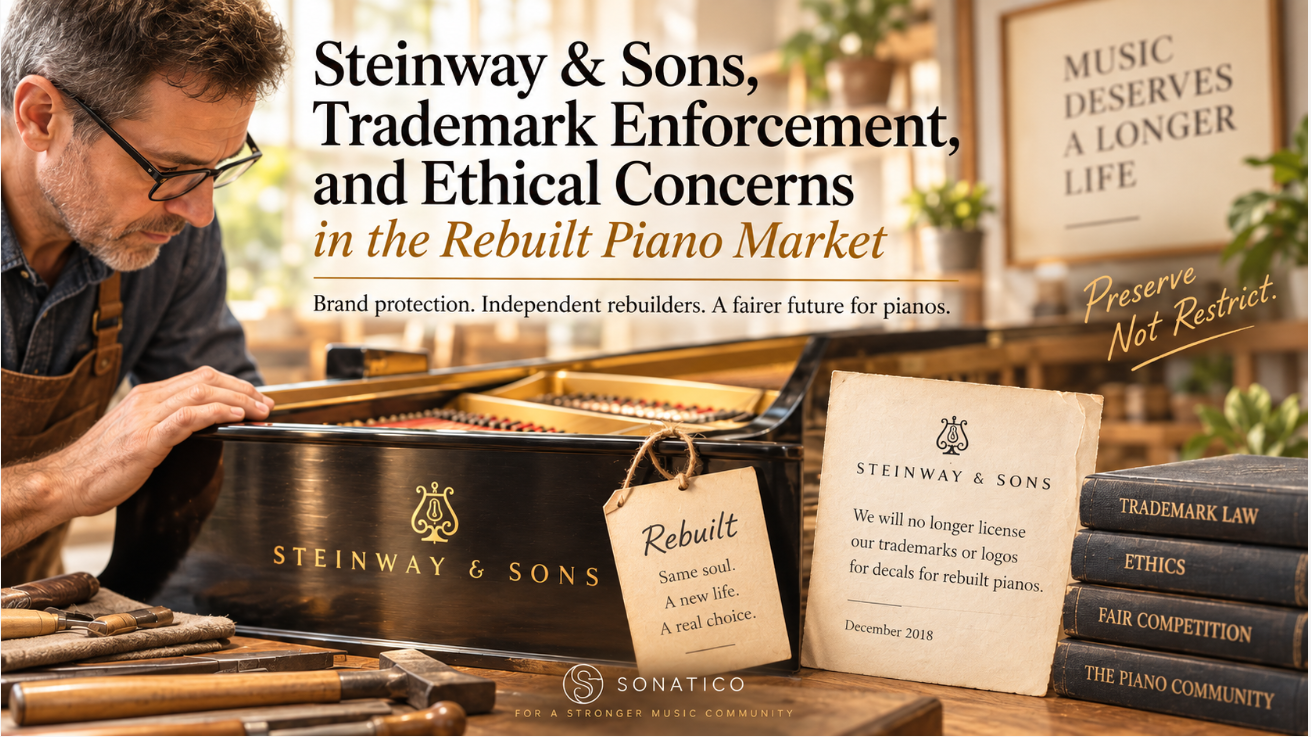
Rebuilt Steinway Pianos: Trademark Policies, Decals, and Questions of Fair Competition
Published · Updated
When a genuine Steinway piano is rebuilt with replacement or aftermarket parts, can it still be described and sold as a Steinway? This article examines Steinway & Sons' trademark rights, its 2018 policy concerning Steinway decals and rebuilt pianos, and the concerns raised by the Piano Technicians Guild about independent piano rebuilders and fair competition. The central issue is the difference between protecting consumers from misleading branding and controlling how an authentic Steinway piano may be restored, serviced, and described. The article argues that clear disclosure--explaining that a piano has been rebuilt, identifying who completed the work, and accurately describing its replacement parts--offers a more balanced approach for manufacturers, rebuilders, and buyers.
How Steinway’s trademark rules affect independent piano rebuilders, buyers, and the piano restoration market
When an older Steinway piano is rebuilt, many parts may need to be repaired or replaced. This raises a question that matters to piano technicians, sellers, musicians, and buyers:
When does a rebuilt Steinway stop being considered a Steinway?
The answer is not as simple as it may first appear.
Steinway & Sons has a legitimate interest in protecting its name. A respected trademark represents the manufacturer’s history, reputation, and standards. Consumers should not be misled into believing that an instrument is new, factory-restored, or officially approved by Steinway when that is not the case.
At the same time, many genuine Steinway pianos remain in use for generations and eventually require substantial restoration. Some are rebuilt by independent piano technicians using a combination of original components, Steinway replacement parts, and aftermarket parts.
This creates an important distinction between two different situations: a competing manufacturer using a confusingly similar name, and an independent technician rebuilding an authentic Steinway piano.
Steinway’s established trademark rights
Steinway’s strong trademark rights were confirmed in the legal dispute involving the German piano manufacturer Grotrian-Steinweg.
In 1973, a federal district court concluded that the name “Grotrian-Steinweg” was likely to cause confusion with the Steinway and Steinway & Sons trademarks. The court found trademark infringement and unfair competition because the two manufacturers were selling competing products under names that could appear connected to American consumers.
The Court of Appeals later affirmed the findings of trademark infringement and unfair competition, although it overturned the award of damages and profits. Justia Law
This case demonstrates that Steinway has the right to protect its brand from another manufacturer whose name or marketing creates confusion.
However, a rebuilt Steinway presents a different question.
A genuine Steinway piano is not a competing product made by another manufacturer. Its original identity is normally established through its manufacture, serial number, and history. The disagreement is not necessarily about who originally made the piano, but about how the instrument was later rebuilt and how it should be described to a buyer.
Steinway’s policy on decals and rebuilt pianos
In December 2018, Steinway informed the Piano Technicians Guild that it would no longer license its trademarks or logos to Decals Unlimited for use on Steinway soundboards and fallboards. Steinway also stated that it would not make replacement decals available through its parts department or other Steinway channels.
According to the policy described by the Piano Technicians Guild, Steinway also took the position that a restored or rebuilt piano should not be marketed as a Steinway unless it contained only genuine Steinway replacement parts, or unless any non-Steinway parts were incidental, specifically disclosed, and accompanied by a clear statement that the piano had been rebuilt and by whom. Piano Technicians Guild
The disclosure requirement is understandable. A buyer should know whether a piano is new, used, restored, or completely rebuilt. The buyer should also understand whether the rebuilding was completed by Steinway, by an authorized facility, or by an independent technician.
The more difficult question is whether the use of aftermarket parts changes the identity of the original instrument—or removes the right to describe it as a Steinway at all.
The Piano Technicians Guild response
The Piano Technicians Guild referred Steinway’s letter to its attorney for review.
The attorney agreed that consumers should be told when a Steinway piano has been rebuilt, particularly when it is being sold beside new Steinway instruments. However, the attorney disagreed with the broader claim that a rebuilt piano could only be marketed as a Steinway if it used Steinway replacement parts.
In the opinion published by the Guild, the attorney stated that Steinway had overstated its trademark rights. The attorney argued that a genuine product does not automatically lose its original identity simply because it has been repaired or rebuilt with non-original parts, provided that the buyer is not misled about its age, condition, parts, or rebuilding history.
The attorney also raised the possibility that preventing independent rebuilders from obtaining Steinway decals could create antitrust concerns by making it more difficult for them to compete in the servicing and rebuilding market. This was a legal opinion provided to the Guild—not a court ruling that Steinway had violated antitrust law. Piano Technicians Guild
That distinction is important.
The published opinion raises a legal and competitive concern, but it does not establish that a violation occurred. Any legal conclusion would depend on the specific facts, the way a piano was marketed, the disclosures made to the buyer, and the applicable law.
The ethical question
The ethical issue is broader than the technical question of trademark law.
Steinway has every right to prevent sellers from falsely presenting an independently rebuilt piano as new, factory-restored, or fully composed of Steinway parts. Buyers deserve accurate information, and the Steinway name should not be used in a misleading way.
The concern arises when trademark protection begins to restrict independent professionals from accurately describing and servicing genuine Steinway instruments.
If an authentic Steinway piano has been rebuilt, it should not be represented as untouched, original, new, or factory-approved. But it should also be possible to communicate its genuine origin, provided that the rebuilding history is presented honestly.
From the author’s perspective, transparency offers a more ethical approach than attempting to control every stage of an instrument’s life after its original sale.
What buyers of rebuilt Steinway pianos should ask
For musicians, teachers, schools, and families considering a rebuilt Steinway piano, the most useful protection is clear information.
A prospective buyer should ask:
- Is the piano being sold as used, restored, or fully rebuilt?
- Who completed the rebuilding work?
- When was the work completed?
- Which major components are original?
- Which components were replaced?
- Were Steinway parts or aftermarket parts used?
- Is the rebuilder independent, Steinway-authorized, or connected to the factory?
- Does the seller have records documenting the work?
- Is the original serial number available for verification?
These questions do not determine the legal status of the instrument, but they help the buyer understand what is actually being purchased.
Clear disclosure also protects responsible rebuilders. A technician who identifies the instrument accurately, explains the work performed, and avoids implying factory authorization gives the buyer a more honest basis for making a decision.
Why this matters beyond the piano industry
This debate reflects a larger question about ownership and repair.
When someone purchases a high-quality instrument designed to last for decades, how much control should the original manufacturer retain over its future servicing, restoration, and resale?
Manufacturers need to protect their reputations. Independent professionals need the ability to maintain and rebuild existing instruments. Consumers need both accurate information and meaningful choice.
These interests do not have to be incompatible.
A workable approach would recognize Steinway’s legitimate trademark rights while also allowing qualified independent rebuilders to describe authentic instruments accurately. The foundation of that approach should be transparency: no false suggestion of factory approval, no concealment of replacement parts, and no confusion about who performed the rebuilding.
Conclusion
The Grotrian-Steinweg decisions established that Steinway may protect its trademarks from competing names that create consumer confusion. Those decisions, however, do not automatically resolve every question involving genuine Steinway pianos rebuilt by independent technicians.
The 2018 decal policy brought attention to the difficult boundary between trademark protection and control of the secondary piano market. The Piano Technicians Guild attorney argued that Steinway’s position went beyond what trademark law permits and raised possible competition concerns. That remains an attorney’s analysis rather than a final judicial determination.
From an ethical perspective, the most balanced path is one that protects the Steinway name while respecting the legitimate role of independent piano rebuilders. Buyers should be told exactly what an instrument is, what work was performed, which parts were used, and who completed the restoration.
A rebuilt piano should never be misrepresented. But neither should brand protection prevent an authentic instrument’s history from being described honestly.
This article presents educational commentary and the author’s interpretation of the cited materials. It is not legal advice.
Works Cited
Grotrian, Helfferich, Schulz, Th. Steinweg Nachf. v. Steinway & Sons. 365 F. Supp. 707. United States District Court for the Southern District of New York. October 1, 1973.
Grotrian, Helfferich, Schulz, Th. Steinweg Nachf. v. Steinway & Sons. 523 F.2d 1331. United States Court of Appeals for the Second Circuit. July 9, 1975.
Piano Technicians Guild. “Letter — Piano Technicians Guild Professional Communities.” February 2019, quoting the Guild attorney’s letter of January 24, 2019.
Related articles
Changing the Connotation of Piano Practice
Many students think of piano practice as something they have to do. But often it isn't the practice itself that creates resistance--it's the way we talk about it. This article explores how piano teachers can use simple changes in language to make piano practice feel more meaningful, enjoyable, and motivating. By replacing directive phrases with language that encourages curiosity, ownership, and musical discovery, teachers can maintain high standards while helping students build confidence and a lifelong love of music.
Justin Vidad-Menezes ·
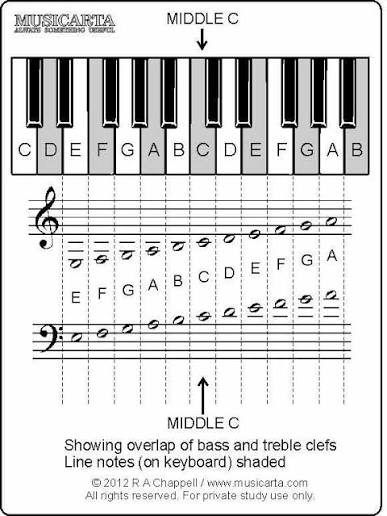
How to Teach Keyboard Geography to Beginners Without Flashcards or Memorization
This document explains why beginner piano students should learn keyboard geography through tactile and spatial activities rather than flashcards or memorization. It argues that flashcards can help with note naming, but they separate notes from the physical experience of finding them on the keyboard. Instead, the document recommends embodied learning strategies that help students develop spatial awareness, pattern recognition, and muscle memory. Suggested activities include using black-key groups as landmarks, moving by intervals, finding repeated notes across the keyboard, and beginning sight-reading exercises by identifying tactile landmarks. The main idea is that students learn the keyboard more deeply when they feel and navigate it as a physical map, rather than simply memorizing note names. This approach is supported by research on tactile learning, haptic feedback, and embodied cognition, and it aims to build confidence, accuracy, and musical independence.
Justin Vidad-Menezes ·
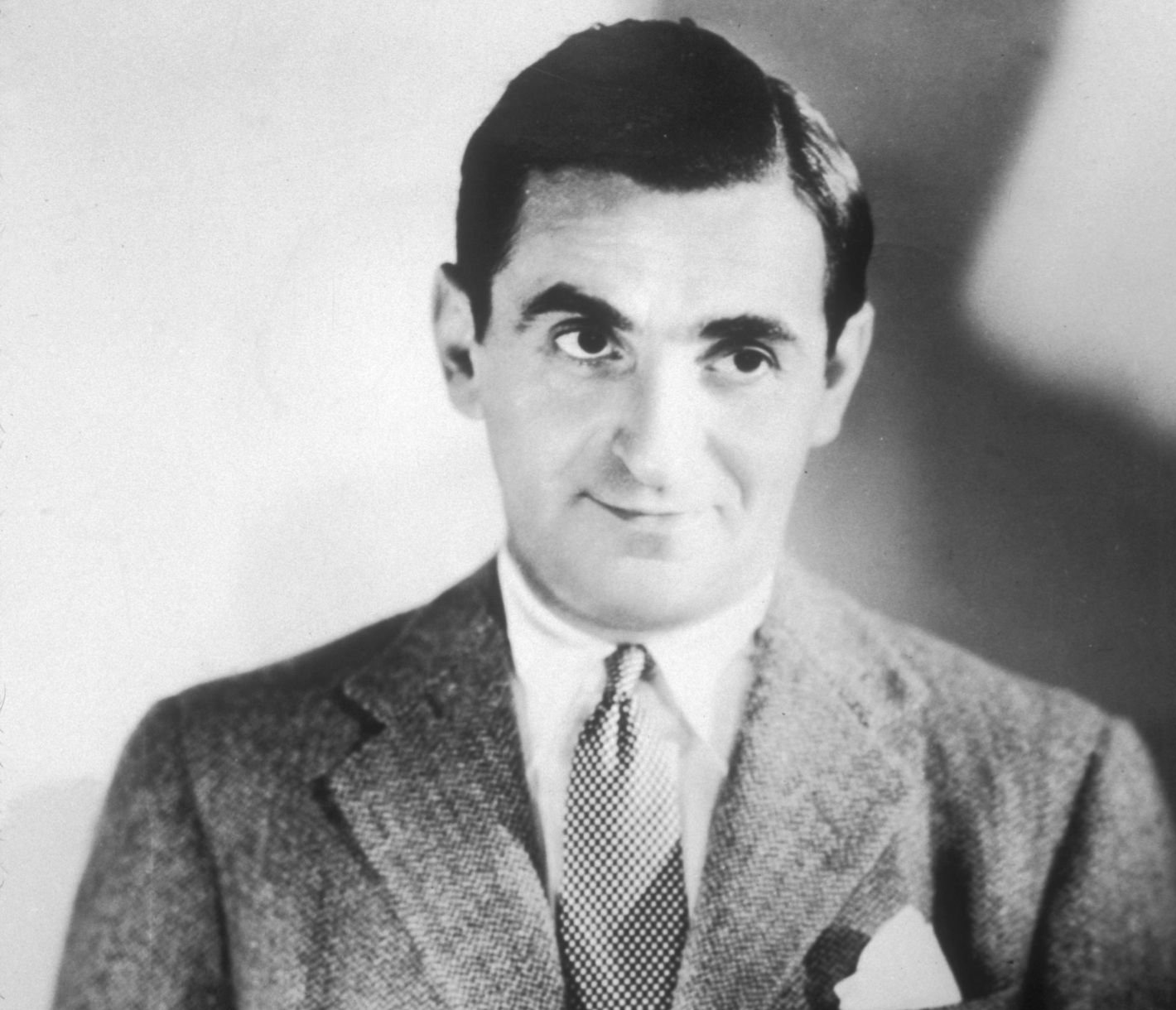
Irving Berlin and the Importance of Developing the Ear in Music
Who Irving Berlin Was (and why he matters): Russian-born American composer and lyricist, active from 1907-1971. Wrote an estimated 1,500 songs, including White Christmas, God Bless America, Blue Skies, Cheek to Cheek, and Puttin' on the Ritz. His music forms a major part of the Great American Songbook. Received an Academy Award, Grammy, Tony, and the Presidential Medal of Freedom. Wrote an estimated 1,500 songs, including White Christmas, God Bless America, Blue Skies, Cheek to Cheek, and Puttin' on the Ritz. His music forms a major part of the Great American Songbook. Received an Academy Award, Grammy, Tony, and the Presidential Medal of Freedom.
Justin Vidad-Menezes ·
Conversation
No comments yet. Start the conversation.
Join the conversation